

Introduction
Waste management is one of the biggest challenges faced by modern cities. With increasing population, urbanization, and consumption, the amount of waste generated every day is rising rapidly.
Improper disposal of waste leads to environmental pollution, health problems, spreading of diseases, and climate change. To solve this issue, a scientific and systematic waste management system is essential.
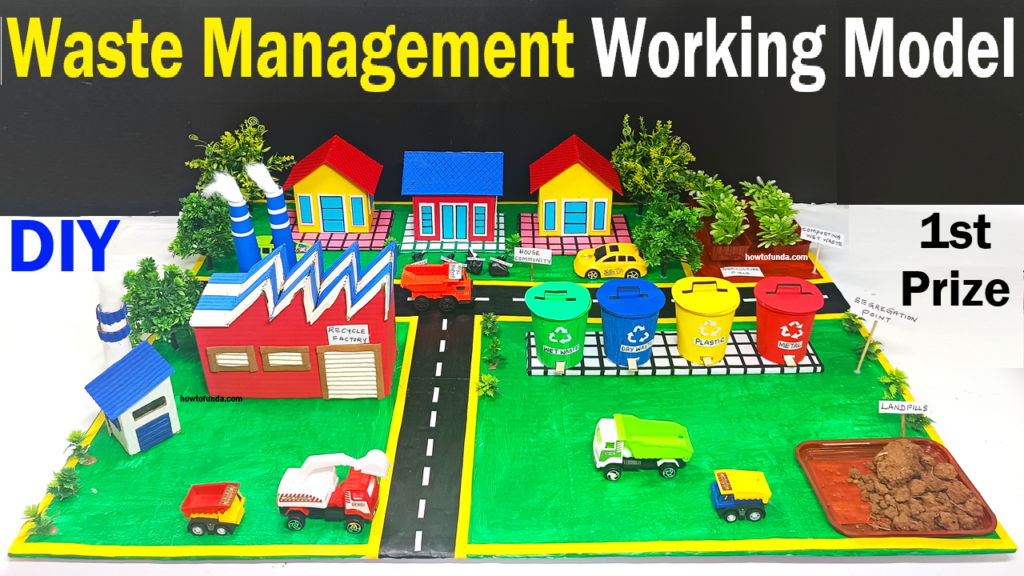
This Waste Management Working Model demonstrates how waste is collected, segregated, recycled, composted, and finally disposed of in landfills in a planned and eco-friendly way.
The model promotes the concept of Reduce, Reuse, and Recycle (3R) and highlights the importance of responsible waste handling for a clean and sustainable future.
Aim of the Project
The aim of this project is to:
- Show the complete cycle of waste management
- Create awareness about waste segregation at source
- Explain recycling, composting, and landfill processes
- Promote environmental protection and sustainability
Importance of Waste Management
Proper waste management is important because:
- It reduces air, water, and soil pollution
- Prevents the spread of diseases and infections
- Saves natural resources through recycling
- Reduces greenhouse gas emissions
- Keeps cities clean, healthy, and livable
Overview of the Waste Management Working Model
This model is designed using simple DIY materials like cardboard, color paper, plastic pipes, bins, and labels. It represents a mini city waste management system, showing how waste moves from homes to its final treatment.
The model includes the following main stages:
- Waste Pickup
- Waste Segregation
- Recycling Unit
- Composting Unit
- Landfill Disposal
Each stage is connected to show the flow of waste in a realistic manner.
1. Waste Pickup System
Waste management starts with waste pickup from homes, schools, offices, and markets.
In the model:
- Houses and buildings generate waste daily
- A municipal waste collection truck collects the waste
- Waste is transported to the segregation center
This step highlights the role of local authorities and municipal workers in maintaining cleanliness. Regular waste pickup prevents open dumping and bad odors.
2. Waste Segregation
Waste segregation is the most important step in waste management.
In the model, waste is separated into:
- Wet Waste (Biodegradable) – food waste, vegetable peels, leaves
- Dry Waste (Non-Biodegradable) – plastic, paper, metal, glass
- Hazardous Waste – batteries, medical waste, chemicals (optional section)
Color-coded bins are used:
- Green bin → Wet waste
- Blue bin → Dry waste
- Red bin → Hazardous waste
Segregation helps in:
- Easy recycling
- Efficient composting
- Reducing landfill load
This stage teaches that segregation should begin at home.
3. Recycling Process
Dry waste collected from the segregation unit is sent to the recycling plant.
In the recycling section of the model:
- Plastic waste is melted and reshaped
- Paper waste is pulped and reused
- Metal waste is melted and reformed
- Glass is crushed and reused
Recycling helps to:
- Save natural resources
- Reduce energy consumption
- Reduce pollution
- Decrease waste sent to landfills
Recycled materials are reused to make new products, showing the concept of a circular economy.
4. Composting of Wet Waste
Wet waste is sent to the composting unit.
In this process:
- Organic waste decomposes naturally
- Microorganisms break down waste
- Compost is formed over time
In the model:
- Compost pits or compost bins are shown
- Finished compost is used in gardens and agriculture fields
Benefits of composting:
- Reduces methane gas emissions
- Produces natural fertilizer
- Improves soil fertility
- Reduces dependency on chemical fertilizers
This step emphasizes how waste can become a useful resource.
5. Landfill Disposal
Waste that cannot be recycled or composted is sent to the landfill.
In the model:
- Landfill is shown away from residential areas
- Waste is covered with soil layers
- Gas vents are shown to release methane safely
Landfills are the last option in waste management. The goal is to minimize landfill waste by maximizing recycling and composting.
Problems with landfills:
- Land pollution
- Methane gas emission
- Groundwater contamination
Hence, reducing waste generation is very important.
Working Principle of the Model
The model works on the principle of systematic waste flow:
- Waste generation → Collection → Segregation → Treatment → Disposal
It shows how scientific planning can convert waste into valuable resources while protecting the environment.
Environmental Benefits
This waste management system:
- Keeps cities clean
- Protects wildlife and ecosystems
- Reduces climate change impact
- Promotes sustainable living
Conclusion
This Waste Management Working Model effectively explains how waste can be managed in a scientific and eco-friendly way. It highlights the importance of waste segregation, recycling, composting, and responsible disposal.
The project teaches us that waste is not useless; when managed properly, it becomes a valuable resource. Every individual has a role to play in waste management by following the 3R principle – Reduce, Reuse, Recycle.
A clean environment starts with responsible waste management.
“Don’t waste waste – manage it wisely.”