

Aim of the Project
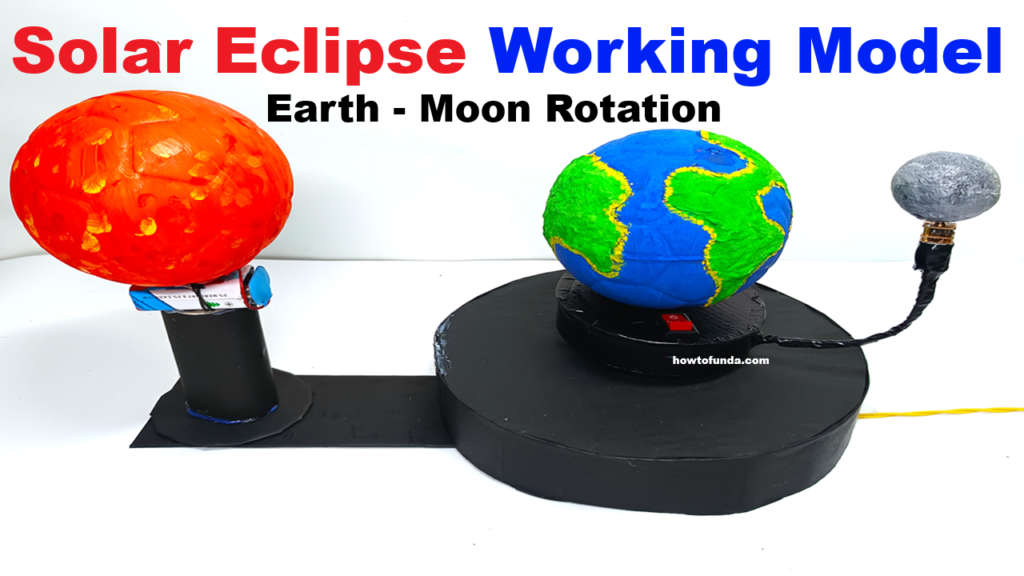
To demonstrate the solar eclipse phenomenon using a rotating Earth and Moon model, showing how the Moon comes between the Sun and Earth, blocking sunlight.
Scientific Principle
A solar eclipse occurs when:
- The Moon moves between the Sun and Earth
- The Moon’s shadow falls on Earth
- Sunlight is partially or fully blocked
Types of solar eclipse:
- Total Solar Eclipse
- Partial Solar Eclipse
- Annular Solar Eclipse
Materials Required
- Thermocol balls:
- Large ball – Sun
- Medium ball – Earth
- Small ball – Moon
- Slow-speed DC motors (2 motors)
- Battery (9V or AA battery pack)
- Switch
- Wires
- Cardboard / Thermocol base
- Wooden sticks or metal rods
- LED or torch (optional – to represent sunlight)
- Black chart paper
- Fevicol / hot glue
- Paint (yellow, blue, white, black)
Model Setup (Structure)
- Sun fixed at one side
- Earth mounted on rotating motor
- Moon mounted on another slow motor
- Earth rotates on its axis
- Moon revolves around Earth
- Light source directed from Sun to Earth
Step-by-Step Construction (DIY)
Step 1: Prepare the Base
- Use a cardboard or thermocol base
- Cover with black chart paper (space)
- Fix Sun on one side using a stand
Step 2: Make the Sun
- Paint the largest thermocol ball yellow
- Fix it firmly (no rotation needed)
- Optional: place LED behind it for brightness
Step 3: Earth Rotation
- Paint medium thermocol ball blue and green
- Fix it on a slow DC motor
- Motor allows Earth to rotate slowly on its axis
Step 4: Moon Revolution
- Paint small thermocol ball white
- Fix it on a rod attached to another slow motor
- Position Moon so it revolves around Earth
Step 5: Electrical Connections
- Connect motors to battery through switch
- Use slow RPM motors for smooth motion
- Turn ON switch to start rotation
Working of the Model
- Sun emits light (LED or torch)
- Earth rotates slowly
- Moon revolves around Earth
- When Moon comes between Sun and Earth:
- Moon blocks sunlight
- Shadow falls on Earth
- Solar Eclipse occurs
This visually demonstrates alignment of Sun, Moon, and Earth.
Observation
- Shadow of Moon on Earth can be seen
- Shows why solar eclipse does not occur every month
- Occurs only when alignment is perfect
Conclusion
This Solar Eclipse Working Model helps students understand:
- Earth–Moon rotation
- Shadow formation
- Cause of solar eclipses
It proves that science concepts become simple and interesting when explained using working models.