
Introduction
An elevator or lift is a commonly used machine in buildings to transport people or goods between floors. It works on the principle of simple machines, especially pulleys, to lift loads with less effort.
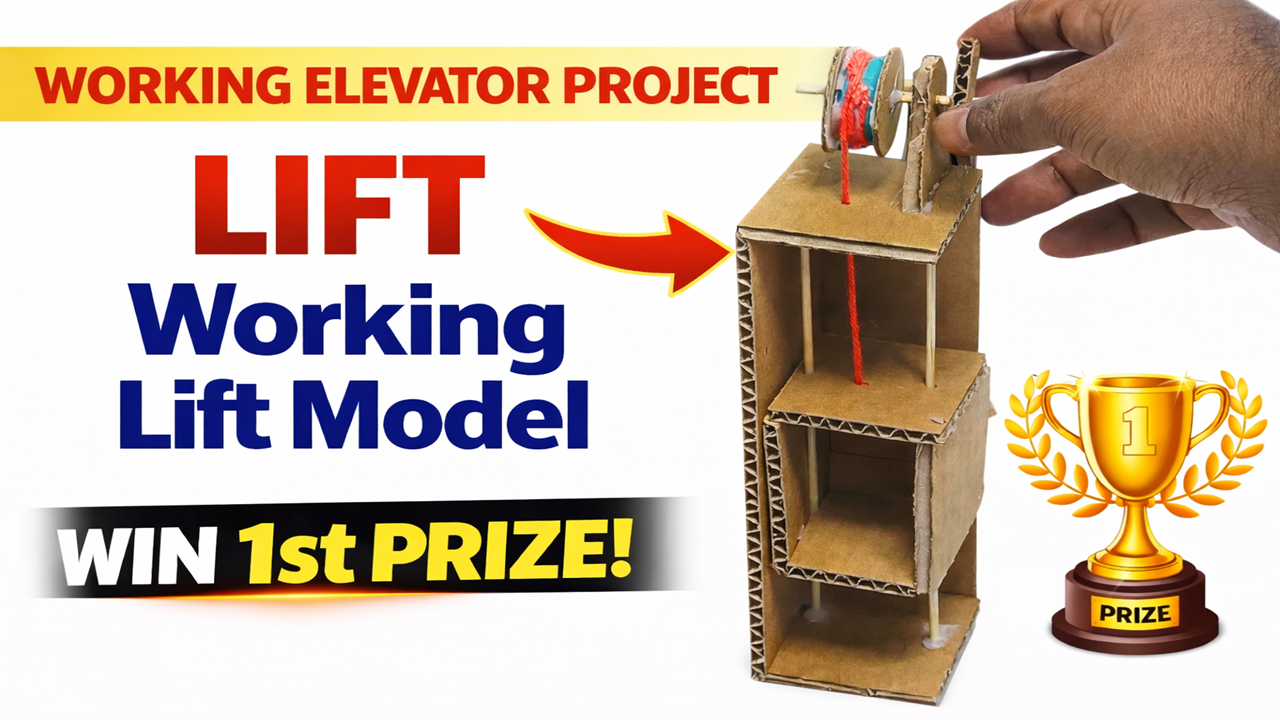
The Lift Working Model is a simple and effective science project that demonstrates how elevators operate using basic physics concepts. This project is ideal for school exhibitions and helps students understand the practical application of pulleys and mechanical systems.
Materials Required
This model can be made using simple and low-cost materials:
- Cardboard (for building structure)
- Thread or rope
- Pulley (or small wheel)
- DC motor (optional for automation)
- Battery
- Wooden sticks or straws (for support)
- Glue, cutter, and tape
- Small box (for elevator cabin)
Working Principle
The lift model works on the principle of a pulley system, which is a type of simple machine.
- A pulley changes the direction of force and makes lifting easier.
- When the rope is pulled downward, the load moves upward.
- If a motor is used, it rotates and winds the rope, lifting the elevator cabin.
- When the rope is released or reversed, the lift moves downward.
This demonstrates how elevators in real buildings use similar mechanisms with motors and cables.
How the Model Works
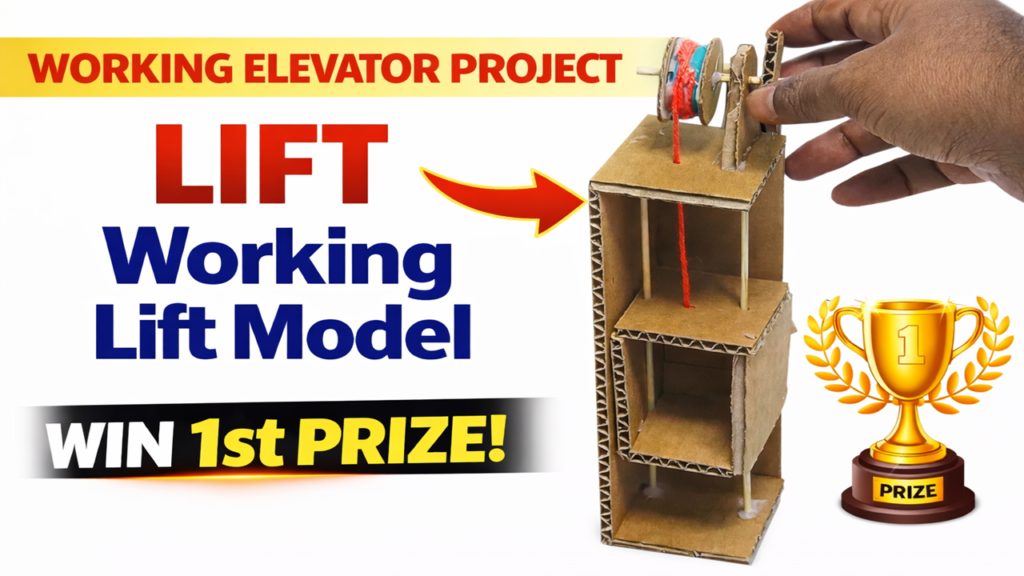
The model consists of a multi-floor structure made from cardboard, with a small elevator cabin placed inside.
- A pulley is fixed at the top of the structure.
- A rope passes over the pulley and is connected to the lift cabin.
- The other end of the rope is connected to a motor or manually operated wheel.
- When the rope is pulled or the motor rotates, the cabin moves upward.
- Reversing the motion lowers the cabin back down.
Guide rods or sticks are used to ensure the lift moves straight without tilting.
Advantages
- Easy to understand basic physics concepts
- Demonstrates real-life application of pulleys
- Low-cost and easy to build
- Ideal for school science exhibitions
- Can be upgraded with motor and automation
Educational Value
This project helps students learn:
- Concept of simple machines (pulleys)
- Force and motion
- Mechanical advantage
- Basic electrical systems (if motor is used)
It also improves creativity, logical thinking, and practical skills.
Applications
- Elevators in buildings
- Lifting systems in construction
- Cranes and hoisting machines
- Industrial lifting equipment
Limitations
- Can lift only small weights
- Requires proper alignment for smooth movement
- Manual models may not be very fast
Conclusion
The Lift Working Model is a simple yet powerful demonstration of how elevators work using pulley systems. It shows how basic physics principles can be applied to create useful machines that make our daily life easier.
This project not only enhances understanding of science concepts but also encourages students to explore engineering ideas. It is an excellent choice for science exhibitions and helps in developing hands-on learning skills.