
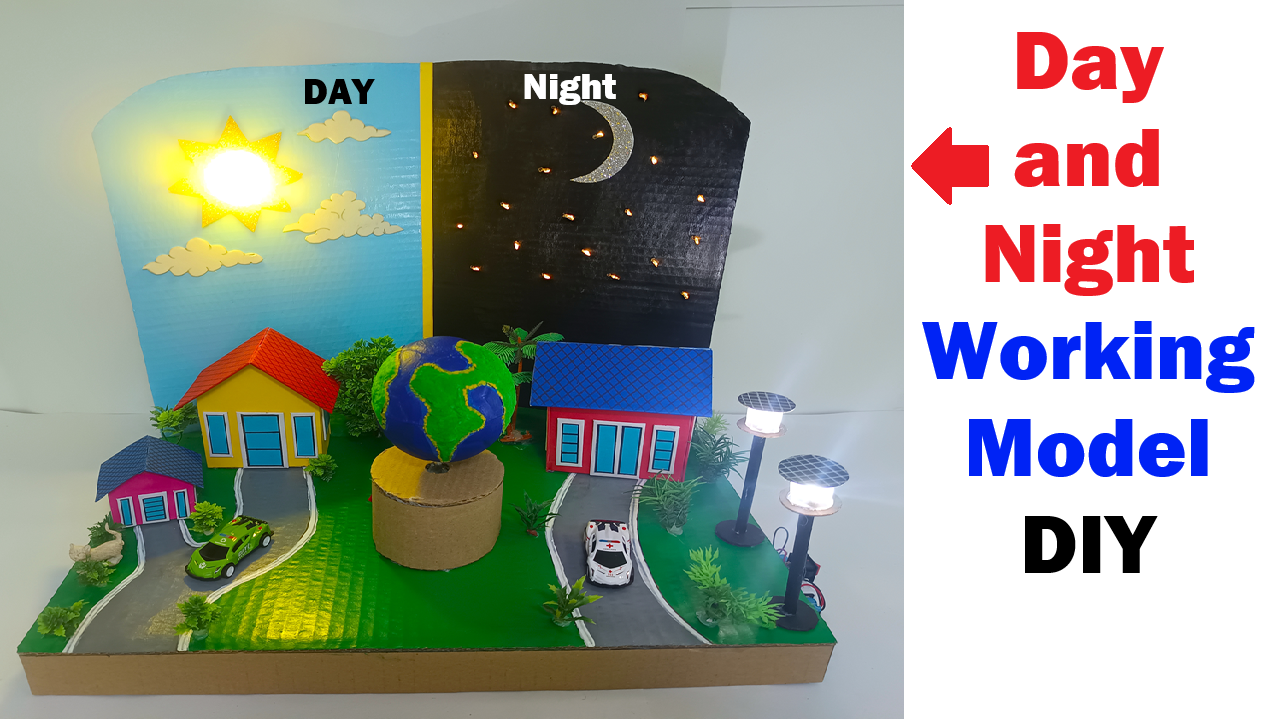
In this video, we show you how to create an amazing Day and Night working model that clearly explains how the rotation of Earth causes day and night. This project uses a rotating Earth model with LED lights to represent sunlight and darkness, making it perfect for school science exhibitions, science fairs, and classroom demonstrations.
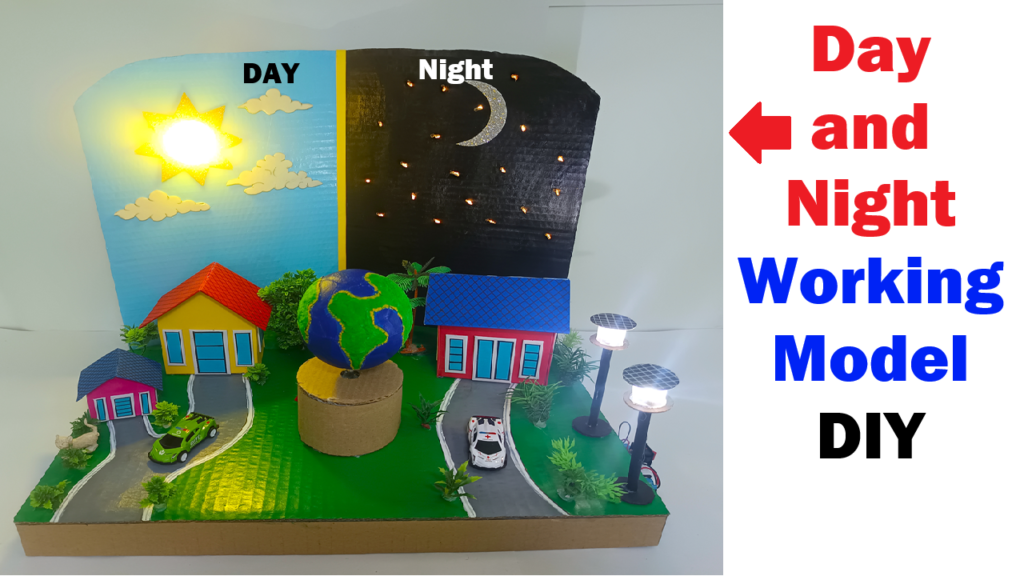
Understanding why day and night occur is one of the most important concepts in Earth science and astronomy. The Earth rotates on its axis once every 24 hours, and this rotation causes different parts of the planet to face the Sun at different times. When a region faces the Sun, it experiences daytime, and when it faces away, it experiences nighttime. This simple but powerful idea becomes crystal clear with this working 3D model.
📌 In this video you will learn:
✔ How to build a 3D model that shows the Earth spinning on its axis
✔ How to use LED lights to simulate sunlight and darkness
✔ How Earth’s rotation creates a cycle of day and night
✔ Tips to make your model look professional and exhibition-ready
🏗️ Materials Used (Simple & Low-Cost):
- A small plastic or foam ball to represent Earth
- LED lights to simulate the Sun’s light
- A DC motor or simple rotation mechanism
- Wires, battery or power supply, and a switch
- Cardboard, baseboard, or stand
- Paints and color paper to decorate the Earth and sky
- Optional: star and cloud decorations for more visual appeal
🛠️ How It Works:
- Build the Base and Background:
Start by preparing a sturdy base (cardboard or wooden board). Paint the backdrop to represent space or sky. - Create the Sun and LEDs:
Position one or more yellow or white LED lights on the base. These act as the Sun’s light source. When switched on, they illuminate the Earth model. - Make the Earth Model Rotate:
Mount the painted Earth ball on a small motor shaft. When the motor runs, the Earth rotates. This rotation mimics the real rotation of our planet. - Simulating Day and Night:
As the Earth rotates, the LED light shines on only one half of the ball at a time. The side facing the LED becomes bright (day), and the opposite side stays dark (night). This visually shows the cycle of daytime and nighttime.
🌞 Why This Model Is Great for Exhibitions:
This model transforms a scientific concept into a tangible, visual learning experience. Instead of just reading or memorizing facts, students and visitors can actually see the Earth spinning and how the light falls on different parts of it. The use of LED lights makes the model more engaging and easier to explain, especially during crowded exhibition halls or classrooms.
📚 Concepts Explained:
- Earth’s rotation on its axis
- The 24-hour day cycle
- Difference between day and night
- Simple mechanics and basic electronics (LEDs, motor)