
Introduction
The phenomenon of day and night is one of the most fundamental and fascinating concepts in astronomy and Earth science. It occurs due to the rotation of the Earth on its own axis, causing different parts of the Earth to face the Sun at different times. When a region of the Earth faces the Sun, it experiences day, and when it turns away from the Sun, it experiences night.
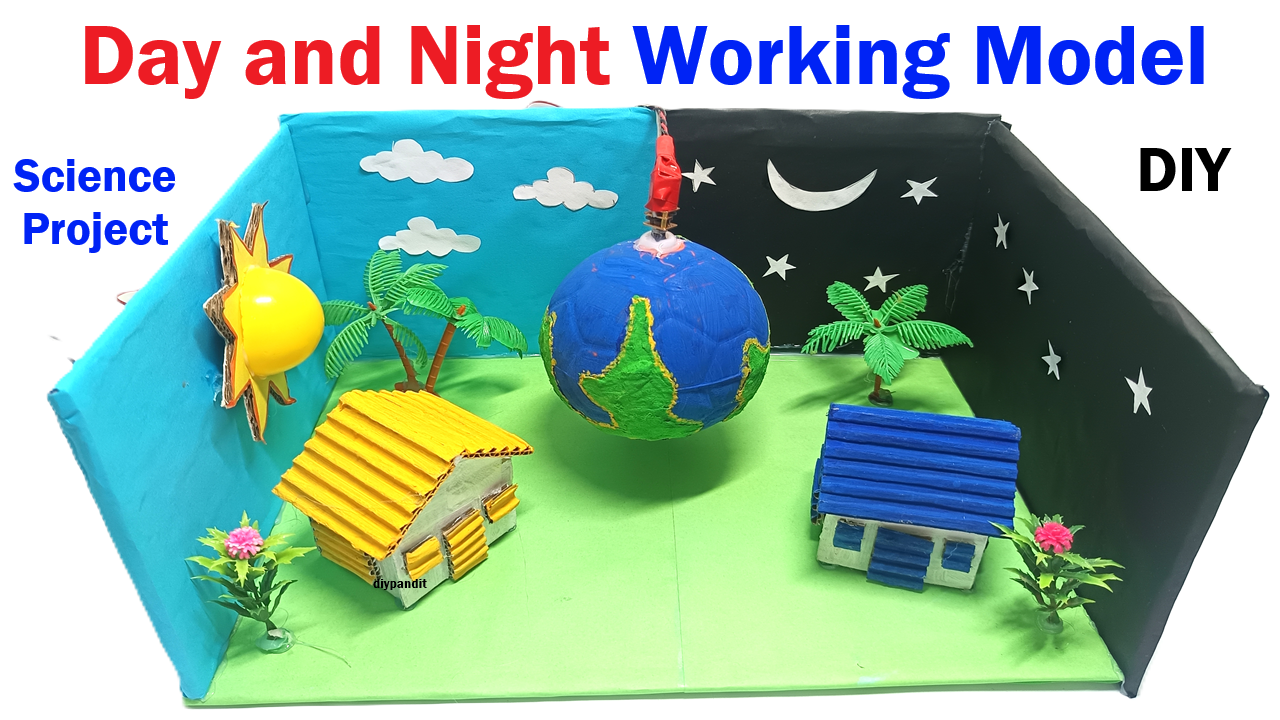
This Day and Night Working Model (3D) is an innovative DIY science exhibition project designed to clearly demonstrate this concept using simple materials. Unlike flat or static models, this 3D rotating model provides a realistic visual understanding of Earth’s rotation, light and shadow, and the continuous cycle of day and night. The model is suitable for school science exhibitions, astronomy demonstrations, and interactive learning.
Aim of the Project
The main aims of this project are:
- To explain the cause of day and night on Earth
- To demonstrate Earth’s rotation using a 3D working model
- To provide a clear visual understanding of sunlight and shadow
- To create an innovative, low-cost DIY science model
- To encourage curiosity and interest in astronomy
Scientific Background
The Earth rotates on its axis once every 24 hours. The axis is an imaginary line passing through the North Pole and South Pole. Due to this rotation:
- One half of the Earth faces the Sun (day)
- The opposite half remains in darkness (night)
The Sun itself does not move around the Earth to cause day and night. Instead, Earth’s rotation is responsible for this daily cycle.
Innovative Concept of the Model
This model is designed with a central light source acting as the Sun and a rotating 3D Earth. The innovation lies in:
- A raised rotating Earth structure
- Clear half-light and half-shadow effect
- Marked continents and time zones
- Manual or motor-based smooth rotation
The model allows viewers to see how different regions of the Earth experience sunrise, noon, sunset, and night.
Materials Used
The materials required for making this model are:
- Cardboard (base and support structure)
- Thermocol ball or paper-mâché sphere (Earth)
- Yellow LED bulb or torch (Sun)
- DC motor or manual rotating rod
- Battery and switch (if motorized)
- Color paper and acrylic paints
- Wooden stick or metal rod (Earth axis)
- Aluminium foil (light reflection)
- Glue, tape
- Scissors and cutter
- Marker pens for labeling
Construction of the 3D Model
- A strong cardboard base is prepared and painted black to represent space
- A vertical support is fixed at the center
- A thermocol or paper-mâché sphere is painted as Earth with continents and oceans
- An axis rod is passed through the Earth at a slight tilt
- The Earth is mounted so it can rotate freely
- A light source representing the Sun is placed on one side
- Optional motor is connected for automatic rotation
- Labels are added for clarity
Description of Model Components
The Sun
The Sun is represented by a yellow LED or bulb. It acts as the main light source and remains fixed. Aluminium foil can be placed behind it to enhance brightness.
The Earth
The Earth is shown as a 3D rotating sphere. One half receives light, while the other remains dark, clearly showing day and night.
Earth’s Axis
A tilted rod passing through the Earth represents the axis. This helps explain Earth’s rotation and also introduces the concept of seasons (optional explanation).
Working Principle of the Model
The working of the model is simple and effective:
- The Sun light is switched ON
- The Earth is rotated slowly on its axis
- The side facing the Sun experiences day
- The opposite side experiences night
- As the Earth rotates, day turns into night and night turns into day
This continuous motion explains the 24-hour cycle.
Demonstration of Time Zones
By marking different countries or time zones on the Earth, the model can also explain:
- Why it is day in one country and night in another
- Sunrise and sunset movement
- Difference in local time
Educational Importance
- Makes abstract concepts visual and clear
- Helps students understand astronomy basics
- Encourages hands-on learning
- Ideal for science exhibitions and viva
Advantages of the Model
- Low-cost and eco-friendly
- Easy to build using cardboard
- Interactive and engaging
- Reusable for classroom teaching
Innovation and Creativity
The innovative aspect of this model includes:
- 3D rotating Earth instead of flat charts
- Realistic light and shadow effect
- Optional motorized rotation
- Combination of physics and astronomy
Applications of the Concept
- Understanding day and night
- Learning about Earth’s rotation
- Introduction to time zones
- Foundation for learning seasons and eclipses
Safety Measures
- Handle cutters carefully
- Use low-voltage batteries
- Avoid direct eye contact with strong light
Conclusion
The Day and Night Working Model (3D) is an innovative and effective science exhibition project that clearly demonstrates the rotation of the Earth and the formation of day and night. By using simple DIY materials like cardboard, a light source, and a rotating Earth, the model transforms a theoretical concept into a visual and interactive learning experience.
This project not only helps students understand basic astronomy but also inspires curiosity about space and the universe. It is an excellent choice for science exhibitions, school projects, and astronomy demonstrations.
Rotation of Earth is the Reason for Day and Night.