
Introduction
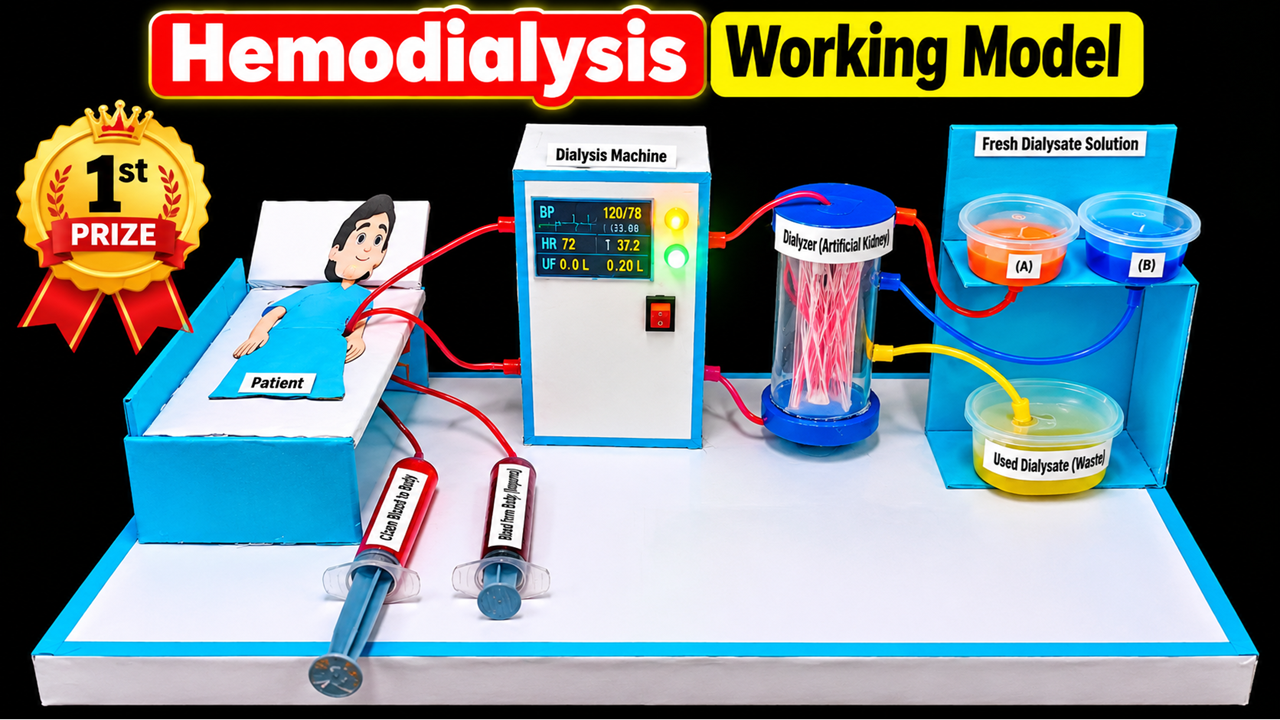
The Hemodialysis Working Model – Artificial Kidney is an innovative biology project that demonstrates how dialysis helps remove waste products from the blood when the kidneys are unable to perform their functions properly. This DIY working model is especially useful for school science exhibitions, biology projects, Inspire Award projects, and educational demonstrations.
The human kidneys are very important organs of the excretory system. They continuously filter the blood and remove waste products, excess salts, and excess water from the body. When the kidneys become severely damaged, these waste products can accumulate in the blood. Hemodialysis is one of the treatments used to help perform some of the filtering functions normally carried out by healthy kidneys.
This working model provides a simple visual representation of the process using easily available materials such as plastic bottles, syringes, transparent tubes, cardboard, colored water, and a dialysis filter or artificial-kidney arrangement.
Aim of the Project
The main aim of this project is to demonstrate the basic working principle of hemodialysis using a simple DIY model.
The model helps students understand:
- Why kidneys are important.
- What happens when kidneys cannot filter blood properly.
- How an artificial kidney can help remove waste products.
- How blood and dialysis fluid move through a dialyser.
- The basic principle of diffusion through a semipermeable membrane.
What Is Hemodialysis?
Hemodialysis is a medical treatment used when the kidneys are no longer able to adequately remove waste products and excess fluid from the blood.
During hemodialysis, blood is taken from the patient’s body and passed through a special filter called a dialyser. The dialyser contains a semipermeable membrane. Dialysis fluid, commonly called dialysate, flows on the other side of this membrane.
Waste substances move from the blood across the membrane into the dialysate. The filtered blood is then returned to the patient’s body.
In simple words, the dialyser acts as an artificial kidney by performing some of the filtering functions of the natural kidneys.
Materials Required
The following materials can be used to construct a simple exhibition model:
- Cardboard or foam board for the base.
- Transparent plastic bottles.
- Large syringes.
- Transparent PVC or aquarium tubes.
- A suitable dialyser or transparent artificial-kidney demonstration chamber.
- Colored water to represent blood.
- Another colored solution to represent dialysis fluid.
- Small connectors and valves.
- Glue or hot glue.
- Color paper for decoration.
- Wooden sticks or cardboard supports.
- Labels and arrows.
- Optional DC motor and pump for automatic circulation.
For a school demonstration, colored water should be used instead of real blood or biological fluids.
Construction of the Model
First, prepare a strong cardboard base to support the complete model. Fix the bottles and dialyser securely on the base.
One bottle can represent the blood entering the dialysis machine. Another container can represent the dialysis fluid. A third container can represent the filtered blood returning to the body.
Connect the containers using transparent tubes. A syringe can be used as a simple manual pump to push the colored water through the system.
The central part of the model should represent the dialyser or artificial kidney. Inside the dialyser, a suitable semipermeable membrane or hollow-fiber demonstration material can be represented.
Use arrows and labels such as Impure Blood, Dialysis Fluid, Dialyser, Waste Products, and Cleaned Blood to make the model easy for judges and students to understand.
Working Principle
The main principle demonstrated by this model is diffusion across a semipermeable membrane.
In the human body, blood contains useful substances as well as waste products. When the kidneys are functioning normally, they filter the blood and remove unwanted substances.
In hemodialysis, the dialyser contains a membrane that separates the blood from the dialysis fluid. Small waste molecules can move across the membrane according to concentration differences, while larger components such as blood cells and important proteins are retained in the blood.
In the model, colored water can be used to represent blood and another solution can represent dialysis fluid. The movement of fluids through the dialyser demonstrates the basic concept of artificial filtration.
How the Model Works
First, the colored water representing impure blood is placed in the blood container.
The syringe or pump pushes the liquid through the connecting tube toward the dialyser.
Inside the dialyser, the blood comes into contact with the membrane.
The dialysis fluid flows on the other side of the membrane.
In an actual dialysis machine, waste products such as urea and excess electrolytes can move from the blood into the dialysis fluid. The dialysis process also helps remove excess water, depending on the treatment settings.
After passing through the dialyser, the filtered blood is directed toward the outlet container representing the blood returning to the body.
The used dialysis fluid, which contains removed waste products, is collected separately.
This continuous process represents the basic concept of how an artificial kidney helps clean the blood.
Role of the Dialyser
The dialyser is the most important component of the model.
It is sometimes called an artificial kidney because it performs some of the important filtering functions of the natural kidneys.
Real dialysers contain many tiny hollow fibers with semipermeable membranes. Blood flows through these fibers while dialysis fluid flows around them. The membrane allows certain small molecules and water to cross while restricting larger components.
For a school model, the exact medical structure does not need to be reproduced. Instead, the model should clearly demonstrate the relationship between blood, membrane, dialysis fluid, and waste removal.
Role of the Syringe or Pump
The syringe acts as a simple blood pump in this DIY model.
In a real hemodialysis machine, a mechanical blood pump maintains controlled blood flow through the dialysis circuit. In the exhibition model, manually pushing the syringe can demonstrate this circulation.
For an advanced version, a small pump and motor can be added to create continuous movement. This can make the project more visually attractive and demonstrate automation.
Why This Project Is Innovative
The project is innovative because it converts a complex medical process into a simple, visible, and understandable working model.
Students can physically demonstrate the movement of fluid through tubes and the filtering concept instead of only explaining the theory from a textbook.
The model can also be enhanced by adding:
- LED indicators.
- A small DC pump.
- Flow-control valves.
- A digital timer.
- Arduino-based monitoring.
- Water-level sensors.
- Pressure sensors.
- LCD display.
- Buzzer alerts.
These additions can transform the basic biology model into an interdisciplinary biology and electronics project.
Difference Between Natural Kidney and Artificial Kidney
A healthy natural kidney performs several important functions. It filters blood, removes metabolic waste, regulates water and electrolyte balance, and contributes to maintaining the body’s internal chemical balance.
Hemodialysis does not completely replace every function of healthy kidneys. Instead, it performs important parts of the blood-filtering function.
Therefore, the model should be explained as a simplified demonstration of dialysis, rather than a complete replica of a human kidney.
Applications
Hemodialysis is an important treatment for people with severe kidney failure. It is performed in hospitals and dialysis centers using specialized medical equipment.
The treatment can help remove waste products and excess fluid from the blood and maintain appropriate levels of certain substances in the body.
This project can help students understand how medical technology can assist patients when an important organ is unable to function adequately.
Advantages of the Working Model
This project has several educational advantages:
- It is inexpensive to construct.
- It uses easily available materials.
- It demonstrates a real medical technology.
- It combines biology with basic engineering.
- It is visually attractive for science exhibitions.
- It encourages students to understand rather than memorize concepts.
- It can be upgraded with electronics and automation.
- It provides an excellent opportunity to explain kidney function and dialysis.
Limitations
This DIY model is only an educational demonstration. It does not perform real blood purification and cannot be used for medical treatment.
The colored water used in the model is only a representation of blood. The membrane, tubes, pumps, and containers used in the project are also simplified representations of professional dialysis equipment.
Real hemodialysis requires highly specialized equipment, trained medical professionals, sterile conditions, precise monitoring, and medically approved materials.
Conclusion
The Hemodialysis Working Model – Artificial Kidney is an excellent innovative biology project for demonstrating how modern medical technology can help people with kidney failure.
The project explains the relationship between the kidneys, blood, dialyser, semipermeable membrane, dialysis fluid, and waste products in a simple and visual way.
By using cardboard, bottles, tubes, syringes, colored water, and a suitable demonstration dialyser, students can create an impressive working model for a science exhibition.
The project also demonstrates an important message: when natural organs cannot perform their functions properly, science and technology can provide innovative methods to support human health.
This makes the Hemodialysis Working Model not only an attractive school project but also an educational demonstration of how biology, medicine, engineering, and innovation can work together to solve real-life problems.