
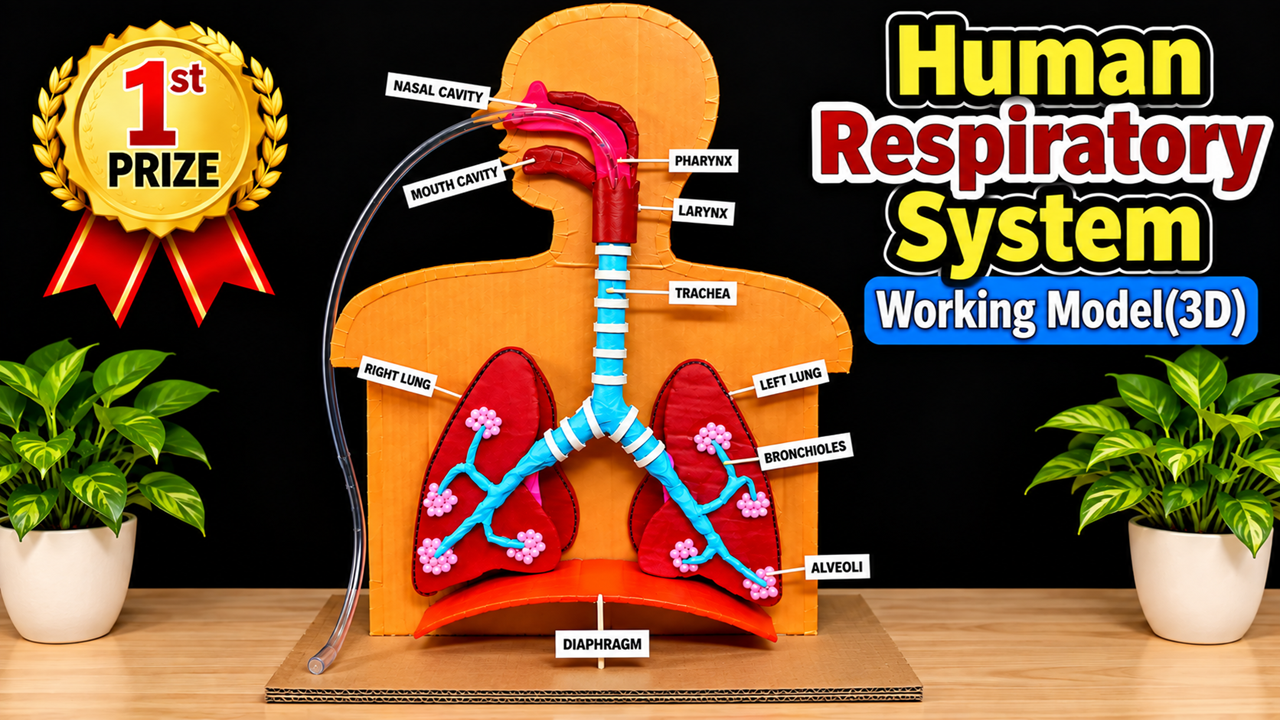
This Human Respiratory System Working Model is an excellent biology science exhibition project that demonstrates how breathing takes place in the human body. The model can be made using balloons, transparent pipes, cardboard, straws, and simple craft materials. The main working principle is based on the movement of air into and out of the lungs when the diaphragm moves downward and upward.
Materials Required
- Cardboard sheet or foam board
- 2 small balloons for the lungs
- 1 larger balloon or flexible rubber sheet for the diaphragm
- Transparent flexible pipe
- Y-shaped connector or two small pipe connectors
- Drinking straws
- Red, blue and orange colour paper
- Glue gun and glue
- Scissors and cutter
- Tape
- Thread or rubber bands
- Marker pen
- Small cardboard pieces for making the nose, mouth and chest
- Wooden sticks for support
- Decorative plants or labels, if required
Step 1: Prepare the Body Structure
Take a large cardboard sheet and draw the outline of the human upper body. Cut the cardboard carefully and cover it with orange or skin-coloured paper. This forms the chest and head portion of the model.
Create a head-shaped section at the top and make openings representing the nasal cavity and mouth cavity. Use coloured paper to represent the pharynx and larynx.
Step 2: Make the Trachea
Take a transparent pipe or suitable drinking straw and place it vertically from the throat area toward the chest. This represents the trachea, also called the windpipe.
You can wrap small white paper rings around the pipe to make it look similar to the cartilage rings present in the real trachea.
At the bottom of the trachea, connect the pipe to a Y-shaped connector. The two branches represent the right and left bronchi.
Step 3: Make the Lungs Using Balloons
Take two balloons of approximately equal size. These balloons represent the right and left lungs.
Connect each balloon to one branch of the Y-shaped connector using transparent pipe or flexible tubing. Secure all connections tightly with tape or rubber bands so that air does not escape.
When air enters the balloons, they expand. When air leaves them, they contract. This provides the main working action of the model.
Step 4: Add Bronchi and Bronchioles
Use smaller transparent tubes or coloured straws to create branches from the main bronchi. These branches represent the bronchioles.
At the ends of the smaller branches, add small pieces of pink or white material to represent the alveoli. In the human respiratory system, alveoli are tiny air sacs where oxygen and carbon dioxide are exchanged.
Step 5: Make the Diaphragm
The most important working component is the diaphragm.
Take a large balloon and carefully cut it so that you obtain a flexible rubber sheet. Stretch this sheet across the bottom opening of the chest section and secure it tightly around the edges.
Attach a small string or stick to the centre of the rubber diaphragm so that it can be pulled downward and pushed upward.
Step 6: Demonstrate Breathing
When the diaphragm is pulled downward, the volume inside the chest cavity increases. This reduces the pressure inside the model, causing air to enter through the transparent pipe and the two balloons to inflate.
When the diaphragm is pushed upward, the volume inside the chest cavity decreases. Pressure increases, causing air to leave the balloons and the balloons to deflate.
Thus, the balloons provide a simple visual demonstration of how the lungs work.
Working Principle
Diaphragm moves down → Chest volume increases → Air enters → Balloons inflate
Diaphragm moves up → Chest volume decreases → Air leaves → Balloons deflate
This model helps students understand the roles of the nasal cavity, mouth, pharynx, larynx, trachea, bronchi, bronchioles, lungs, alveoli, and diaphragm. The use of transparent pipes makes the airflow easier to visualize, while the balloons clearly demonstrate lung expansion and contraction.
The project is inexpensive, reusable, and easy to demonstrate during a science exhibition. It provides a practical way to understand the basic mechanism of human breathing and respiration without requiring complicated electronic components.