
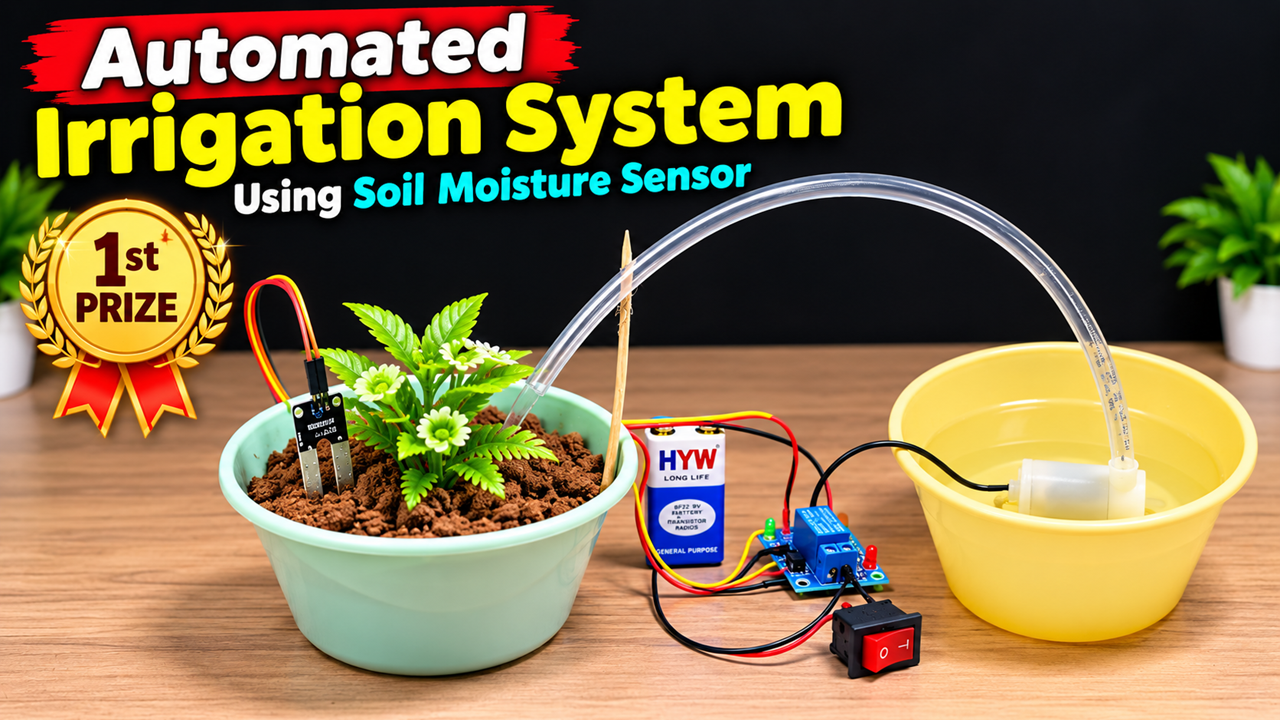
An Automated Irrigation System using a Soil Moisture Sensor is a simple and useful science exhibition project that demonstrates how technology can be used to water plants automatically. The main purpose of this model is to supply water to a plant whenever the soil becomes dry and stop watering when sufficient moisture is detected. This system helps save water, reduces manual effort, and demonstrates an important application of smart farming and automation.
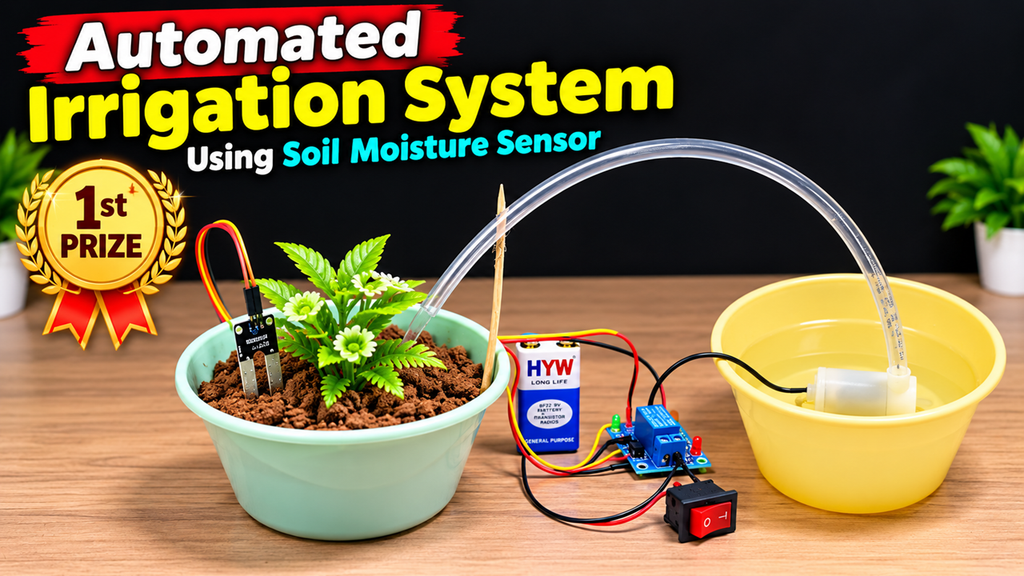
Materials Required
For making this model, you will need a small plant pot, soil, a soil moisture sensor, soil moisture sensor control module, a 5V relay module, a small DC water pump, a suitable battery or DC power supply, transparent water pipe, water container, connecting wires, a switch, cardboard or wooden base, and decorative materials. A 9V battery can be used for demonstration only if the voltage requirements of the selected pump and modules are compatible. Always match the pump and power supply specifications.
Step 1: Prepare the Base
Take a strong cardboard, foam board, or wooden sheet and use it as the base of the model. Place a small plant pot on one side and a water container on the other side. The water container acts as the source from which the pump draws water.
Arrange the battery, sensor module, relay, switch, and wiring neatly between the plant and water container. This makes the project easier to understand during the science exhibition.
Step 2: Install the Soil Moisture Sensor
Insert the two metal probes of the soil moisture sensor into the soil near the plant. Do not push the sensor too deeply into the soil.
Connect the sensor probe to its control module. The module generally has VCC, GND, and signal/output connections. Connect VCC and GND to the appropriate power supply and connect the output signal to the relay/control circuit according to the module’s specifications.
The sensor detects changes in the electrical conductivity of the soil. Moist soil generally conducts electricity better than dry soil, allowing the module to determine whether the soil needs water.
Step 3: Connect the Relay
Connect the sensor output to the relay module’s input. The relay works as an electrically controlled switch.
When the soil becomes dry and the sensor reaches the selected threshold, the relay changes its state and supplies power to the water pump. When sufficient moisture is detected, the relay switches the pump off.
Adjust the small potentiometer on the sensor module to set the desired moisture threshold.
Step 4: Install the DC Water Pump
Place the DC water pump inside the water container. Connect a transparent pipe to the pump outlet and position the other end of the pipe above the plant.
Make sure the pump is completely suitable for the voltage of your power supply. For example, a 5V pump should be powered with an appropriate 5V supply, while a 12V pump requires an appropriate 12V supply.
Secure the pipe so that water falls directly onto the soil rather than outside the pot.
Step 5: Test the System
Switch on the main power supply and test the system.
When the soil is dry, the moisture sensor detects the low moisture level. The sensor sends a signal to the relay, and the relay switches ON the water pump. The pump draws water from the container and sends it through the pipe to the plant.
As water reaches the soil, the moisture level increases. Once the sensor detects sufficient moisture, the relay switches OFF the pump. This prevents unnecessary watering.
Working Principle
The complete operation can be represented as:
Dry Soil → Sensor Detects Low Moisture → Relay ON → Pump ON → Water Supplied → Soil Becomes Moist → Relay OFF → Pump OFF
This project demonstrates the practical use of sensors, switching circuits, DC motors, pumps, and automation. It can be extended for multiple plants, greenhouse systems, terrace gardens, and agricultural irrigation. The model demonstrates how smart irrigation can provide water according to the actual moisture requirement of plants, helping reduce water wastage and human effort.