
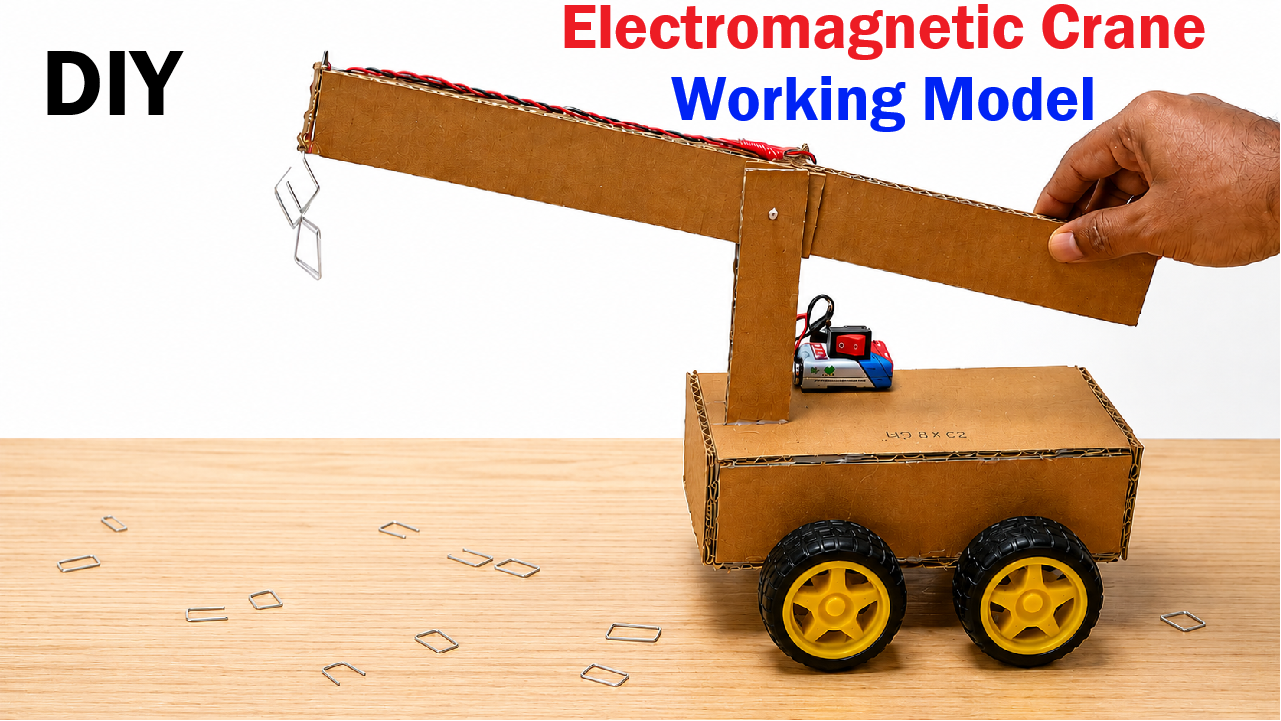
An Electromagnetic Crane Working Model is an interesting and practical science project that demonstrates the important concept of electromagnetism. This DIY model shows how electricity can be used to create a temporary magnetic field and how that magnetic force can be used to lift and move iron and steel objects.
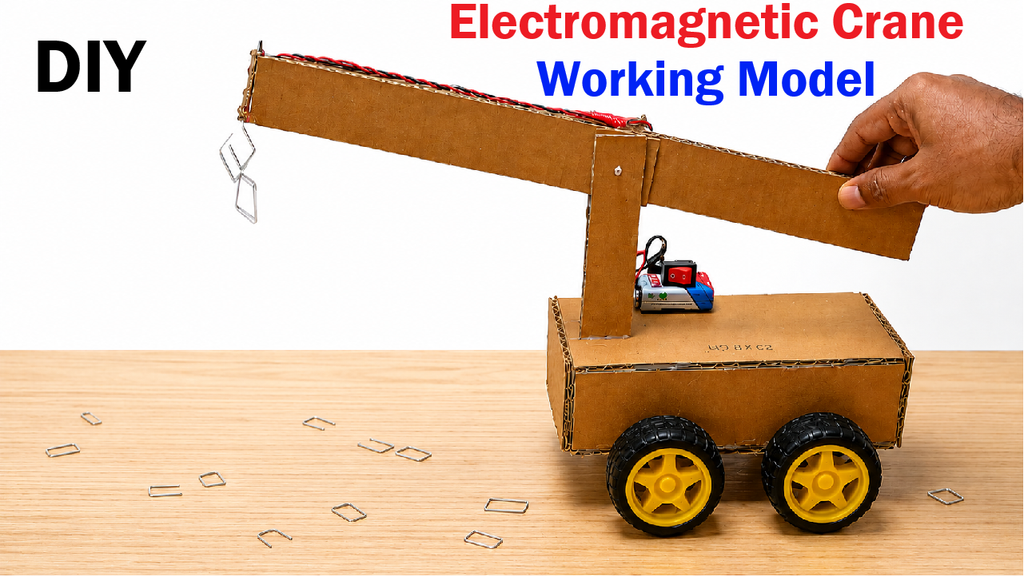
The model shown uses a simple cardboard crane structure, wheels, a long crane arm, an electromagnet, and a power source. It is designed to resemble the cranes used in scrap yards, recycling centres, construction sites, warehouses, and industrial areas.
This project is an excellent choice for a school science exhibition, STEM activity, DIY working model, physics project, or classroom demonstration.
What is an Electromagnet?
An electromagnet is a magnet that is produced when electric current flows through a coil of wire, usually wound around a ferromagnetic core such as an iron nail or iron rod.
Unlike a permanent magnet, an electromagnet can be switched ON and OFF.
The basic principle is:
Electric Current → Magnetic Field → Electromagnetic Force
When the power supply is switched ON, current flows through the coil and creates a magnetic field around the iron core. The iron core becomes strongly magnetized and can attract suitable metal objects.
When the power is switched OFF, the magnetic effect largely disappears, allowing the objects to be released.
Objective of the Project
The main objective of this project is to demonstrate how an electromagnet can be used to lift metallic objects.
The model helps students understand:
- Electromagnetism
- Magnetic fields
- Electric current
- Electromagnets
- Magnetic attraction
- Industrial applications of electromagnets
- Conversion of electrical energy into magnetic effects
Materials Required
To build a similar model, you can use:
- Cardboard
- Iron nail or iron bolt
- Insulated copper wire
- Battery or suitable DC power supply
- Switch
- Connecting wires
- Cardboard box
- Wooden sticks
- Small toy wheels
- Glue
- Tape
- Scissors
- Paper clips or small iron pieces
- Paint or coloured paper
The crane structure can be made almost entirely from cardboard, making the project inexpensive and easy to construct.
How to Make the Electromagnet
The electromagnet is the most important part of the project.
Take an iron nail or iron bolt and wind insulated copper wire around it several times. Leave enough wire at both ends to connect it to the power supply.
The turns of wire should be arranged neatly around the iron core.
Connect the two ends of the coil to a battery through a switch.
When the switch is turned ON, current flows through the coil and produces a magnetic field. The iron core becomes magnetized and can attract suitable ferromagnetic objects such as iron paper clips.
When the switch is turned OFF, the magnetic field is greatly reduced and the objects can be released.
How the Crane Works
The cardboard base represents the crane vehicle. Wheels are attached to the bottom so that the model resembles a mobile industrial crane.
A vertical cardboard support holds the long horizontal crane arm.
The electromagnet is suspended from the end of the crane arm using a wire or thread.
When the electromagnet is lowered near metal objects, the operator turns ON the switch.
The electromagnet attracts the iron objects and lifts them.
The crane arm can then be moved or positioned over another area. When the switch is turned OFF, the magnetic force decreases and the objects fall or are released.
This demonstrates how electromagnetic cranes can pick up and transport large quantities of suitable metal materials.
Science Behind the Project
The project is based on the relationship between electricity and magnetism.
Whenever electric current flows through a conductor, it produces a magnetic field around the conductor. When the wire is wound into a coil, the magnetic fields produced by the individual turns combine, creating a stronger magnetic effect.
Placing an iron core inside the coil further strengthens the electromagnet.
The strength of an electromagnet can depend on factors such as:
- Number of turns of wire
- Amount of current
- Type and size of the iron core
This makes the electromagnet different from a permanent magnet because its magnetic effect can be controlled electrically.
Real-Life Applications
Electromagnets are widely used in technology and industry.
Large electromagnetic cranes are used in scrap-metal yards and recycling facilities to pick up and move iron and steel objects.
Other applications of electromagnets include:
- Electric motors
- Electric bells
- Relays
- Loudspeakers
- Magnetic locks
- Magnetic separators
- Industrial lifting equipment
- Some electrical switching systems
Therefore, this small school model represents a technology that has important real-world applications.
Exhibition Explanation
A student can explain the model like this:
“This is an Electromagnetic Crane Working Model. The crane uses an electromagnet to lift iron objects. When electric current flows through the coil of wire wound around the iron core, a magnetic field is produced and the iron core becomes an electromagnet. When we switch the current ON, the electromagnet attracts iron objects and lifts them. When we switch the current OFF, the magnetic effect is reduced and the objects are released. This principle is used in industries and scrap yards to move iron and steel materials.”
Advantages of an Electromagnetic Crane
The model demonstrates several advantages of electromagnets:
- Magnetic force can be switched ON and OFF.
- It can lift suitable iron and steel objects.
- The magnetic strength can be varied through design.
- It allows quick loading and unloading of metal materials.
- It demonstrates a practical application of electricity and magnetism.
Conclusion
The Electromagnetic Crane Working Model is a simple, low-cost, and highly educational DIY project for a science exhibition. It transforms the theoretical concept of electromagnetism into a visible working demonstration.
The project clearly shows that electric current can create a magnetic field, and that this magnetic field can be used to lift suitable ferromagnetic objects. By combining a cardboard crane, wheels, an electromagnet, and a switch, students can demonstrate an important industrial application of physics in an engaging way.
The model can also be upgraded by adding a stronger but appropriately designed low-voltage electromagnet, a motorized crane arm, remote control, or Arduino-based operation.