
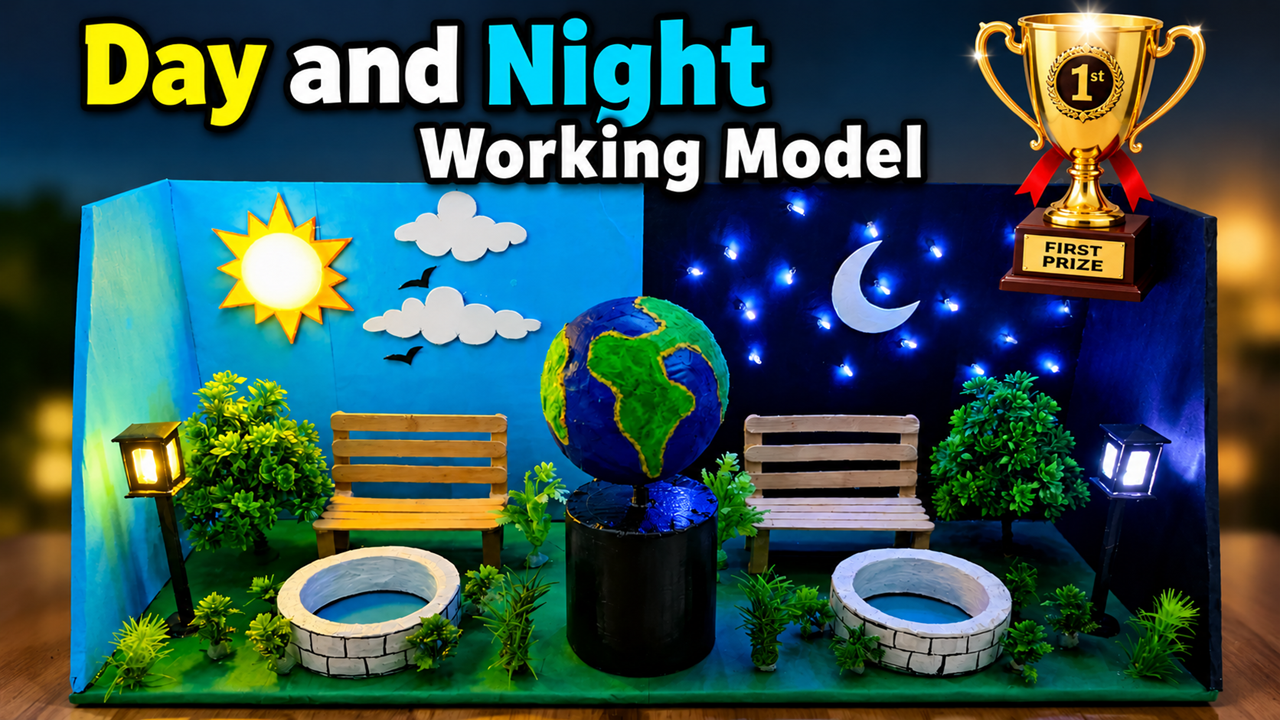
The Day and Night Working Model is a creative and attractive science exhibition project that demonstrates how the rotation of the Earth causes day and night. This DIY model presents the Earth, Sun, Moon, daytime scene, nighttime scene, and illuminated surroundings in a visually appealing way.
The concept of day and night is one of the most fundamental topics in Earth and space science. Although we experience sunrise, daytime, sunset, and nighttime every day, this model helps students understand why these changes occur through a simple three-dimensional demonstration.
Objective of the Project
The main objective of this working model is to explain that Earth rotates on its axis, and this rotation produces the cycle of day and night.
The model helps students understand:
- Rotation of the Earth
- Earth’s axis
- Day and night
- Position of the Sun
- Earth’s approximately 24-hour rotation period
- Difference between the illuminated and dark sides of Earth
- Basic concepts of Earth and space science
It is suitable for a school science exhibition, STEM project, geography project, astronomy activity, Inspire Award-style project, or classroom demonstration.
Materials Required
The model can be made using easily available craft materials such as:
- Cardboard or foam board
- Chart paper
- Thermocol or modelling clay
- Small globe or handmade Earth
- Wooden sticks
- LED lights or fairy lights
- Battery pack
- Wires
- Glue
- Paint
- Artificial plants
- Ice-cream sticks
- Small benches
- Paper for the Sun and Moon
- Decorative materials
The colorful landscape, benches, trees, lamps, Earth, Sun, and Moon make the model visually attractive for an exhibition.
How the Model Represents Day and Night
The model is divided into two main sections.
The bright blue section represents daytime. It contains a bright Sun, clouds, birds, trees, and a well-lit environment.
The dark blue section represents nighttime. It includes a crescent Moon and small lights that represent stars.
At the centre is the Earth, which is the most important part of the demonstration.
The key idea is that the side of Earth facing the Sun receives sunlight and experiences day, while the opposite side is away from the Sun and experiences night.
Science Behind Day and Night
Earth is constantly rotating around an imaginary line called its axis.
The Earth completes approximately one rotation in 24 hours.
As Earth rotates:
- The side facing the Sun receives sunlight → Day
- The side facing away from the Sun receives little or no direct sunlight → Night
Therefore, day and night are caused primarily by the rotation of Earth on its axis, not by the Sun moving around Earth.
This is the central scientific principle demonstrated by the model.
Working Principle
For a working version, the Earth can be mounted on a rotating shaft connected to a small DC motor.
When the motor is switched on, the Earth slowly rotates around its axis.
A light source can be positioned to represent the Sun.
As the Earth rotates, different parts of its surface move into the light and then into darkness.
This provides a direct visual demonstration of the day-night cycle.
For a school exhibition, the Earth does not need to rotate at the actual speed of Earth. The rotation can be slowed down or demonstrated manually so that visitors can clearly observe the concept.
Role of the Sun
The Sun is represented by the bright object on the daytime side of the model.
The Sun provides the light that illuminates Earth. The side of Earth facing the Sun experiences daylight.
The opposite side remains in darkness.
This simple arrangement helps students understand why different places on Earth experience day and night at different times.
Role of the Moon
The Moon is shown on the nighttime side of the model as an additional space-science element.
Students should understand that the Moon does not cause nighttime. Night occurs because a particular part of Earth is facing away from the Sun.
The Moon is included to make the model more attractive and to represent the night sky.
Exhibition Explanation
A student can explain the project like this:
“This is a Day and Night Working Model. Day and night occur because the Earth rotates on its axis. The side of Earth facing the Sun receives sunlight and experiences day, while the side facing away from the Sun experiences night. Earth takes approximately 24 hours to complete one rotation. In this model, the rotating Earth demonstrates how different parts of our planet move between sunlight and darkness.”
Educational Importance
This project converts a textbook concept into a visual and hands-on learning experience. Students can easily understand that Earth is continuously rotating even though we do not feel its motion directly.
The model can also introduce students to related concepts such as:
- Earth’s axis
- Rotation
- Revolution
- Sunrise and sunset
- Time zones
- Different times of day
- Earth’s position relative to the Sun
Future Improvements
The model can be upgraded by adding:
- A motorized rotating Earth
- An LED Sun
- A switch to control rotation
- A digital timer
- Labels showing day and night
- A 24-hour clock
- Time-zone indicators
- An Arduino controller
- Automatic sunrise and sunset lighting
An Arduino and motor can make the model more interactive and turn it into an advanced STEM working model.
Conclusion
The Day and Night Working Model is a simple, creative, and effective science exhibition project for explaining Earth’s rotation. The combination of a rotating Earth, bright daytime scene, dark nighttime scene, Moon, lights, and landscape makes the scientific concept easy to visualize.
The most important message of the project is:
“Earth’s rotation on its axis causes the regular cycle of day and night.”
This DIY project not only improves students’ understanding of astronomy and Earth science but also encourages creativity, model-making skills, scientific thinking, and confident presentation.