
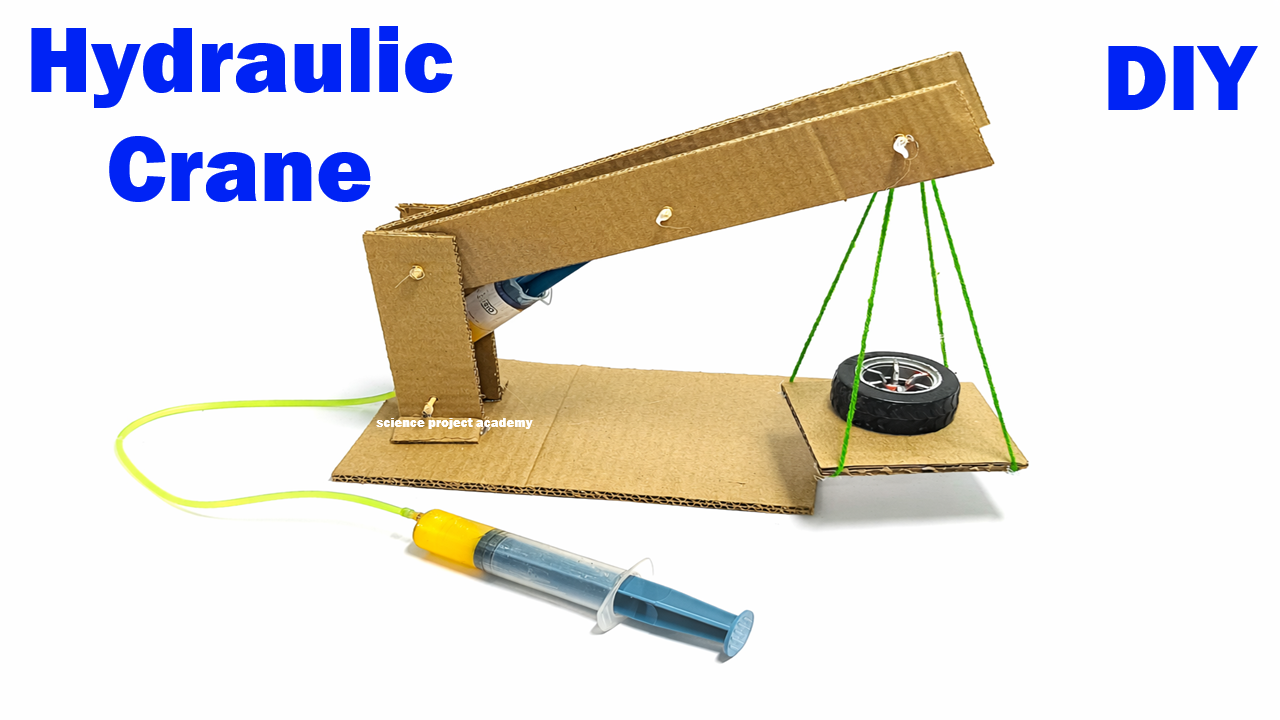
A hydraulic crane is a machine used to lift and move heavy objects using hydraulic pressure. This hydraulic crane working model is a simple DIY science project made using cardboard, syringes, and plastic tubes.
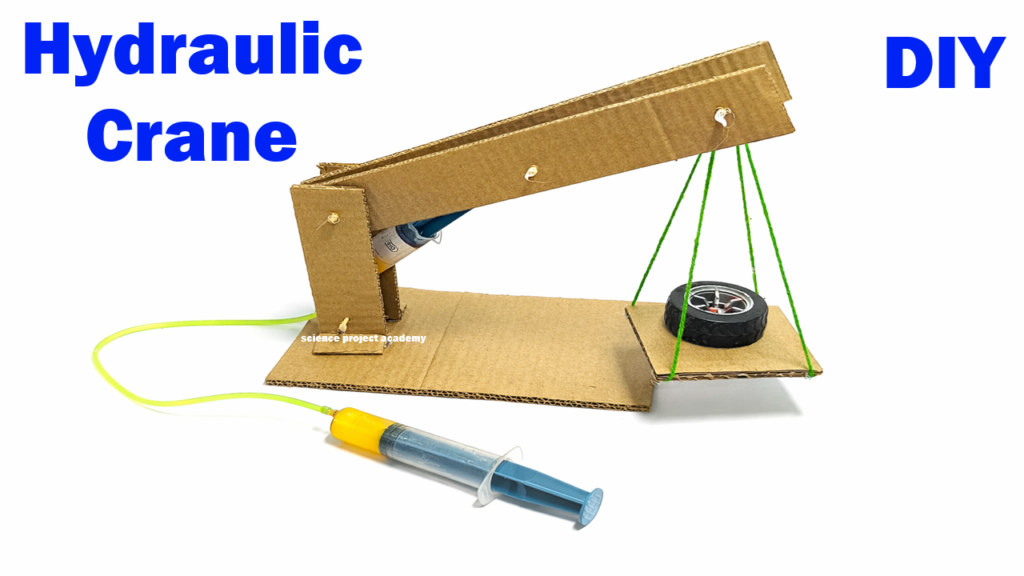
It is an excellent project for school science exhibitions because it demonstrates the principle of hydraulics and Pascal’s Law in a practical and interesting way. The project is easy to make, low-cost, and helps students understand how cranes and hydraulic systems work in real life.
Aim of the Project
The aim of this project is to create a hydraulic crane model using syringes and cardboard to demonstrate the working principle of hydraulic pressure and lifting mechanisms.
Materials Required
- Cardboard sheets
- Two syringes
- Plastic tube
- Glue gun or adhesive
- Cutter and scissors
- Wooden sticks or skewers
- Thread or string
- Small object or toy wheel as load
- Tape and ruler
How to Make the Hydraulic Crane
Step 1: Prepare the Base
Take a thick cardboard sheet and cut it into a rectangular shape. This will act as the base of the crane. Make sure the base is strong and stable.
Step 2: Build the Crane Stand
Cut cardboard pieces to make a vertical support stand. Attach the stand firmly to the base using glue. This support will hold the crane arm.
Step 3: Make the Crane Arm
Cut a long strip of cardboard and fold it to create a strong crane arm. Fix one end of the arm to the vertical support using a wooden stick so that it can move up and down freely.
Step 4: Attach the Syringe System
Take two syringes and connect them using a plastic tube filled with water. One syringe will act as the control syringe and the other as the lifting syringe.
Fix the lifting syringe between the crane stand and the crane arm. When pressure is applied through the control syringe, the lifting syringe moves and raises the crane arm.
Step 5: Add the Load Platform
Attach strings to the end of the crane arm and connect them to a small cardboard platform. Place a small toy wheel or object on the platform to demonstrate lifting.
Step 6: Test the Model
Press the control syringe slowly. The water pressure moves the second syringe, causing the crane arm to rise. Pull the syringe back to lower the arm. This demonstrates the working of a hydraulic crane.
Working Principle
This hydraulic crane works on Pascal’s Law. Pascal’s Law states that pressure applied to a liquid is transmitted equally in all directions. When pressure is applied to one syringe, the water inside the tube transfers the force to the second syringe. This force moves the crane arm and lifts the object.
Hydraulic systems are widely used in cranes, excavators, car lifts, brakes, and other heavy machines because they can lift large loads with less effort.
Advantages of the Model
- Easy and economical project
- Demonstrates Pascal’s Law clearly
- Improves creativity and practical learning
- Helps understand hydraulic systems
- Attractive for science exhibitions
Applications
- Construction cranes
- Hydraulic lifts
- Excavators and bulldozers
- Vehicle braking systems
- Industrial machines
Conclusion
The Hydraulic Crane Working Model is a creative and educational science project that explains the concept of hydraulic pressure in a simple way. It helps students understand how cranes lift heavy objects using fluid force. The model is low-cost, easy to build, and highly useful for demonstrating scientific principles in school science exhibitions.