
Good morning everyone.
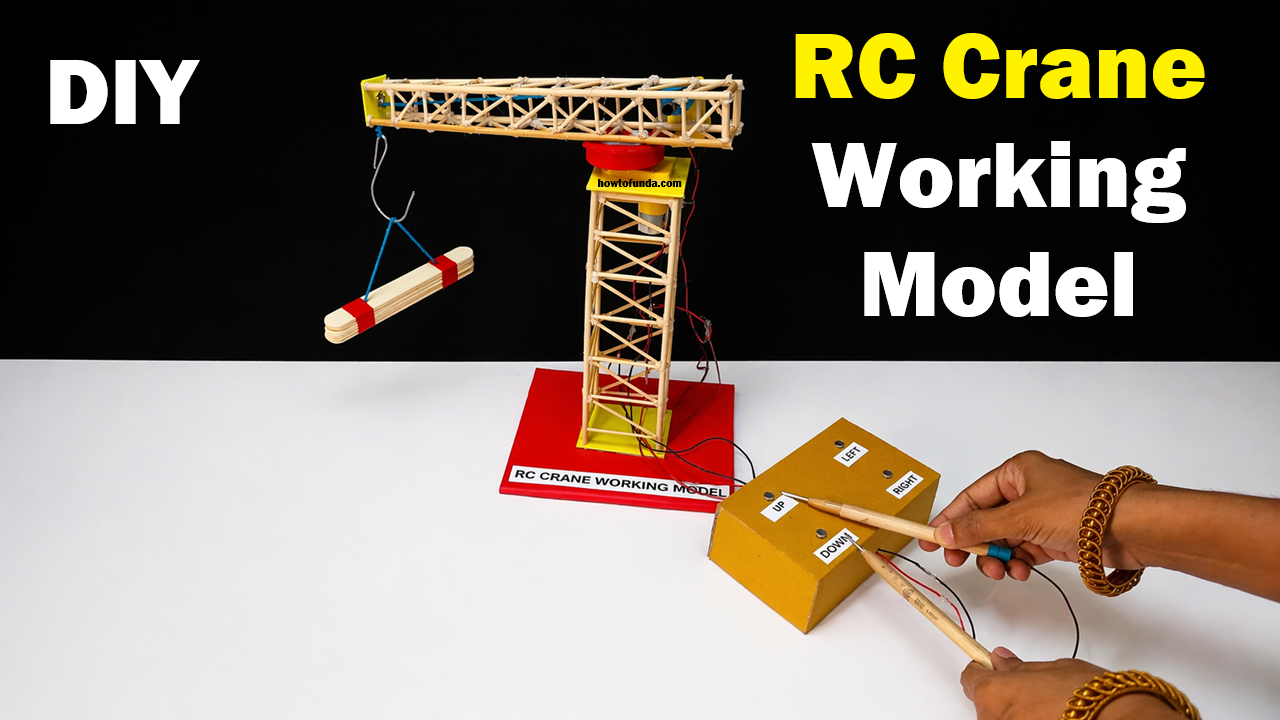
Today I am going to explain my science project on “RC Crane Working Model.” This is a creative and innovative DIY project designed for science exhibitions and Inspire Award competitions. The model demonstrates the working of a remote-controlled tower crane used in construction sites for lifting and moving heavy materials.
This project is made using simple materials such as cardboard, sticks, DC motors, wires, and a remote-control system. It explains important scientific concepts like mechanical movement, electricity, motors, and remote-control technology.
Introduction to RC Crane
A crane is a machine used to lift and move heavy objects from one place to another. Cranes are commonly used in:
- Construction sites
- Industries
- Harbors
- Warehouses
The RC Crane model works like a real tower crane. It can:
- Move up and down
- Rotate left and right
- Lift lightweight objects
- Rotate 360 degrees
This makes the project realistic, interactive, and educational.
Aim of the Project
The main aim of this project is:
- To understand the working of cranes
- To demonstrate remote-control technology
- To explain mechanical and electrical systems
- To encourage creativity and innovation
Parts of the RC Crane Model
The project consists of the following main parts:
1. Tower Structure
The vertical tower supports the entire crane. It is made using sticks or cardboard arranged in a strong framework.
The tower keeps the crane balanced and stable.
2. Crane Arm
The long horizontal arm is used for lifting and moving loads. It is attached to the top of the tower and connected with motors.
3. Hook and Thread System
The hook is used to lift small objects. A thread connected to the motor helps move the hook up and down.
4. DC Motors
The crane uses small DC motors for movement.
Different motors are used for:
- Rotating the crane
- Lifting the hook
- Moving the arm
Motors convert electrical energy into mechanical movement.
5. Remote Control System
The cardboard control box acts as the remote controller.
Buttons or switches are used to control:
- Up movement
- Down movement
- Left rotation
- Right rotation
This makes the model fully functional and interactive.
Working of the RC Crane
The working process is simple and interesting.
Step 1 – Power Supply
The battery provides electricity to the motors.
Step 2 – Remote Operation
When a control switch is pressed, electrical signals reach the motor.
Step 3 – Motor Movement
The motor rotates and creates mechanical movement.
Step 4 – Crane Action
The crane rotates or lifts objects depending on the switch pressed.
The crane can rotate in different directions and move loads easily.
Materials Used
This DIY project is made using:
- Cardboard
- Ice cream sticks or wooden sticks
- DC motors
- Battery
- Wires
- Glue gun
- Thread and hook
- Switches
- Paint and colors
How to Create the Model
Step 1 – Build the Tower
Use sticks or cardboard to create a strong vertical tower structure.
Step 2 – Make the Crane Arm
Create the horizontal arm and attach it to the top of the tower.
Step 3 – Fix Motors
Attach motors for rotation and lifting movement.
Step 4 – Connect Hook Mechanism
Use thread and a hook connected to a motor for lifting objects.
Step 5 – Create Control Box
Make a remote controller using switches and cardboard.
Step 6 – Connect Wiring
Connect motors, battery, and switches properly.
Step 7 – Decorate the Model
Paint and decorate the crane to make it attractive.
Advantages of the RC Crane
- Demonstrates real engineering concepts
- Encourages creativity and innovation
- Helps students understand machines
- Interactive and attractive for exhibitions
- Improves STEM learning skills
Real-Life Applications
Tower cranes are used in:
- Building construction
- Shipping ports
- Factories
- Material handling industries
They help lift heavy objects safely and efficiently.
Conclusion
In conclusion, this RC Crane Working Model is an innovative and educational science project that demonstrates the working of remote-controlled cranes using motors and electrical circuits.
The project explains important concepts such as remote control systems, mechanical movement, electricity, and engineering design in a practical and creative way.
This model is highly suitable for school science exhibitions, STEM activities, and Inspire Award competitions because it combines innovation, creativity, and real-life applications.