
Introduction
The animal cell is the basic structural and functional unit of life in animals. Understanding its structure and functions is essential in biology.
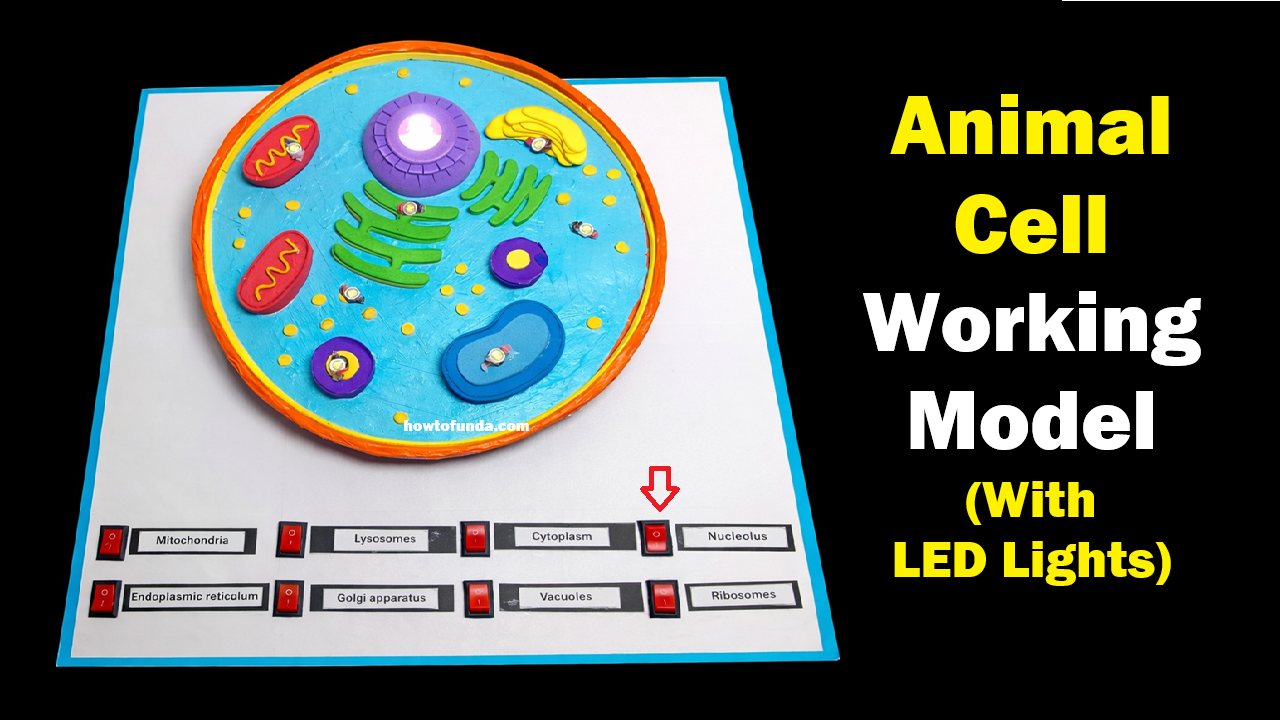
This Animal Cell Working Model with LED Lights is an innovative and interactive way to demonstrate the different parts of a cell and their functions. It is an ideal project for school science exhibitions, helping students visualize complex concepts in a simple and engaging manner.
Materials Required
This model can be created using simple and easily available materials:
- Cardboard or thermocol base
- Colored clay or foam sheets
- LED lights
- Battery
- Connecting wires
- Switches
- Glue and scissors
- Labels for organelles
Working Principle
The working model is based on a simple electrical circuit. Each part of the animal cell (organelle) is connected to an LED and a switch.
- When a switch is turned ON, the LED corresponding to a specific organelle glows.
- This highlights the selected part of the cell.
- It helps in identifying and explaining the function of each organelle interactively.
This combination of biology and basic electronics makes learning more effective and interesting.
Structure of the Animal Cell
The model represents different organelles of an animal cell, each with a specific function:
- Cell Membrane: Outer boundary that controls entry and exit of substances
- Cytoplasm: Jelly-like substance where all cell activities occur
- Nucleus: Control center of the cell containing genetic material
- Nucleolus: Helps in ribosome production
- Mitochondria: Known as the powerhouse of the cell (energy production)
- Ribosomes: Responsible for protein synthesis
- Endoplasmic Reticulum (ER): Helps in protein and lipid transport
- Golgi Apparatus: Modifies and packages proteins
- Lysosomes: Break down waste materials
- Vacuoles: Store substances like water and nutrients
Each of these parts is clearly shown in the model using different colors and shapes.
Working Model Explanation
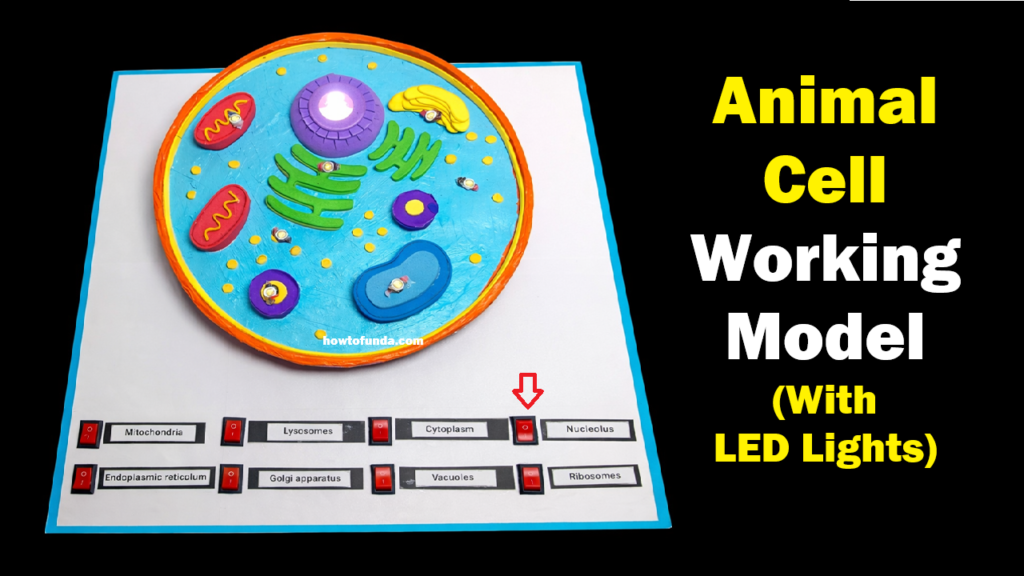
The model is designed on a flat base with a 3D representation of the animal cell. Each organelle is connected to a labeled switch.
- When a switch is pressed, the LED near that organelle lights up.
- The glowing light draws attention to that specific part.
- The student can then explain its structure and function.
For example, when the “Mitochondria” switch is turned on, the LED near it glows, indicating its role in energy production.
Advantages
- Makes learning interactive and fun
- Easy identification of cell parts
- Improves understanding and memory
- Combines biology with basic electronics
- Ideal for exhibitions and competitions
Educational Value
This project helps students understand:
- Structure and function of animal cells
- Role of different organelles
- Basics of electrical circuits
- Hands-on learning and creativity
Applications
- School science exhibitions
- Biology practical demonstrations
- Teaching aid in classrooms
- Interactive learning models
Limitations
- Requires careful wiring
- LEDs and connections need proper handling
- Limited to demonstration purposes
Conclusion
The Animal Cell Working Model with LED Lights is a creative and effective way to learn biology. It transforms theoretical concepts into a visual and interactive experience.
By combining science and creativity, this project enhances understanding and makes learning enjoyable. It is a perfect example of how simple materials and basic electronics can be used to explain complex biological systems in an easy and engaging way.