
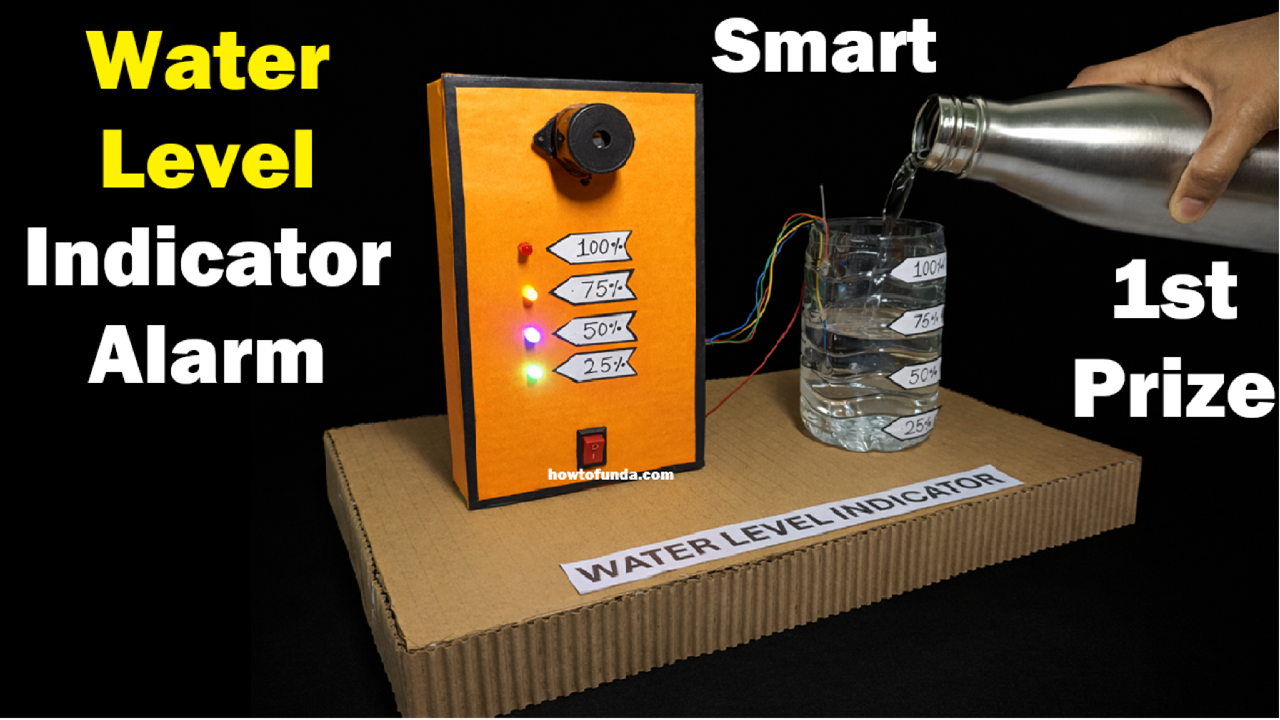
A Water Level Indicator with Alarm is an electronic system designed to detect and display the level of water in a container or tank. It helps prevent water overflow and ensures efficient water usage.
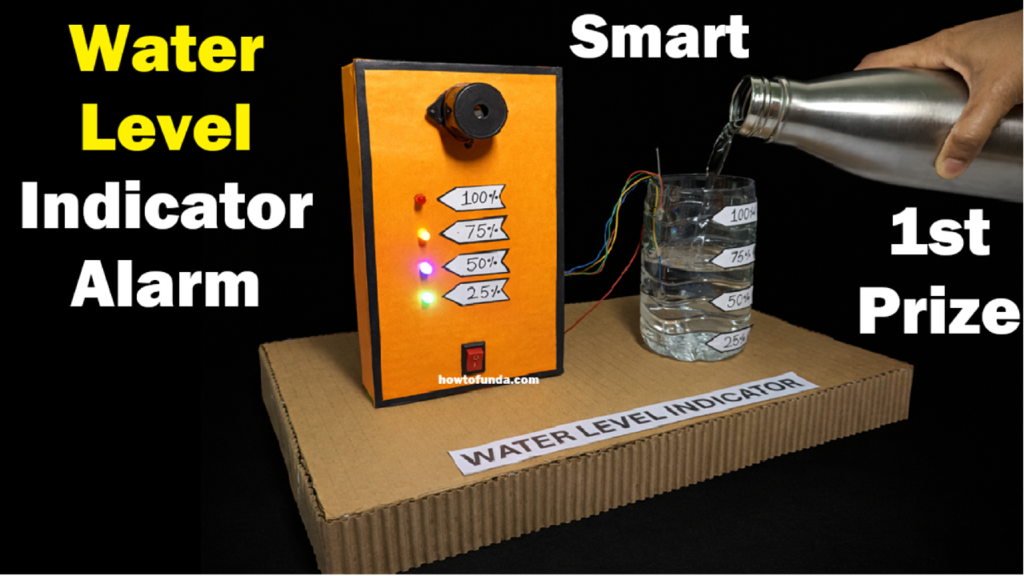
This project is commonly used in homes, industries, and water storage systems to monitor water levels automatically. The model shown in the project demonstrates how different water levels can be indicated using LEDs along with an alarm when the tank becomes full.
Working Principle
The working principle of the water level indicator is based on the conductivity of water. Water naturally contains minerals and impurities that allow it to conduct electricity. In this project, several metal probes or wires are placed at different heights inside the water container. Each probe corresponds to a particular level of water such as 25%, 50%, 75%, and 100%.
Components
The main components used in this project include LED lights, resistors, connecting wires, a buzzer (alarm), a power supply (battery), and a circuit board. Each LED represents a specific water level. When the water rises and touches a probe, it completes an electrical circuit. This allows current to flow and the corresponding LED glows, indicating the current level of water in the tank.
How IT Works
For example, when the water reaches the first probe, the 25% LED lights up. As the water level increases and touches the second probe, the 50% LED turns on. Similarly, the 75% LED glows when water reaches the third probe. Finally, when the tank becomes full and water touches the highest probe, the 100% indicator activates. At this stage, a buzzer or alarm sounds to notify the user that the tank is full. This alarm helps prevent water overflow and wastage.
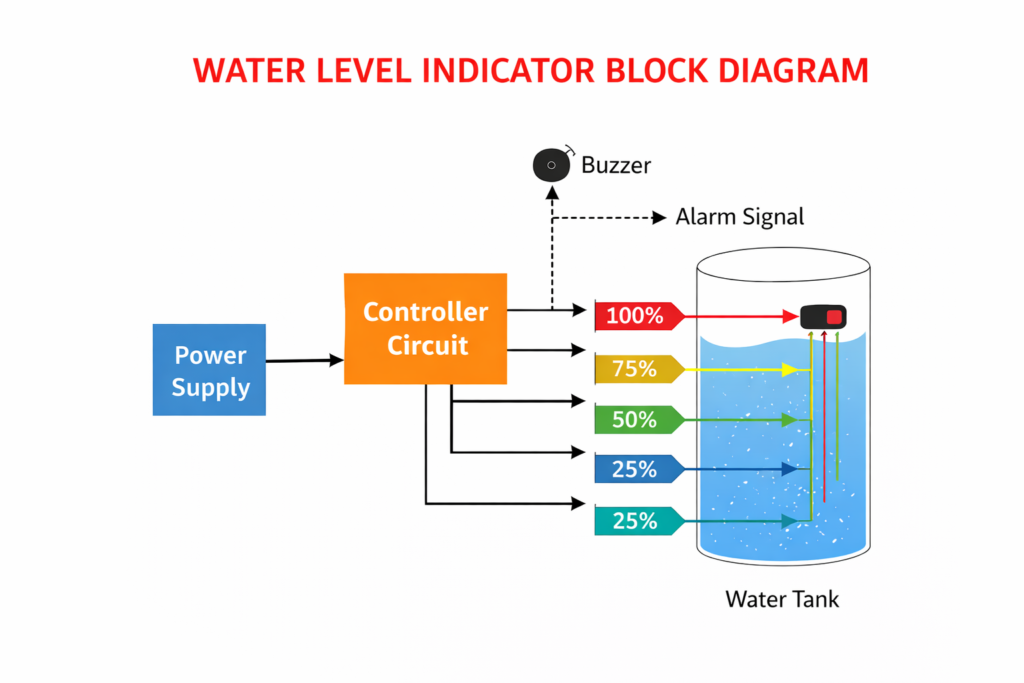
The indicator panel in the model clearly shows the different levels using colored LEDs. The wires connected from the probes inside the container are linked to the indicator circuit inside the box. As water touches each probe, the signal travels through the wires and activates the corresponding LED on the panel.
Advantages
This project has many practical advantages. It saves water, prevents overflow, reduces electricity consumption, and minimizes the need for manual monitoring of water tanks. It is also simple, cost-effective, and easy to build, making it a popular project for science exhibitions and educational demonstrations.
Conclusion
In conclusion, the Water Level Indicator with Alarm is a useful electronic system that provides a clear visual indication of water levels and alerts users when the tank is full. It demonstrates the application of basic electronics and the conductive properties of water to solve real-life problems efficiently.