
Introduction
Agriculture is the backbone of many economies, and irrigation plays a vital role in ensuring healthy crop growth. Traditionally, irrigation systems rely on electricity or diesel-powered pumps to supply water to agricultural fields. However, these methods can be expensive, environmentally harmful, and unreliable in rural areas where electricity supply may be limited. To overcome these challenges, solar irrigation systems have become an effective and sustainable solution.
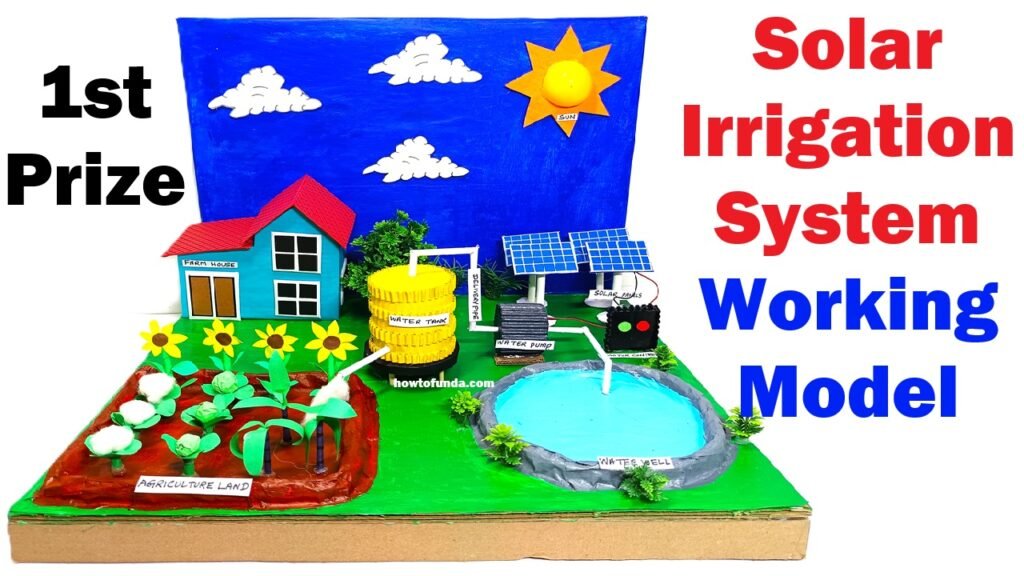
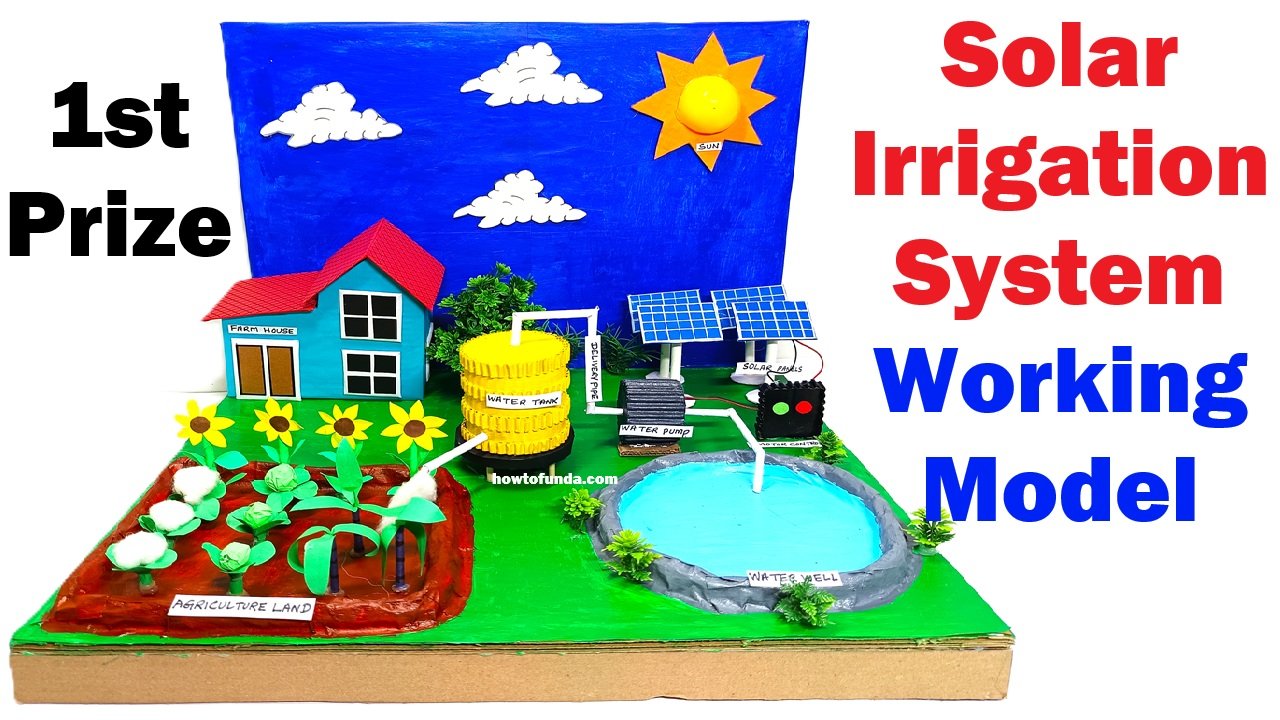
The model shown in the image represents a solar irrigation working model, which demonstrates how solar energy can be used to pump water from a water source and supply it to agricultural land. This project highlights the importance of renewable energy in farming and shows how sunlight can power irrigation systems without using fossil fuels. The model includes elements such as solar panels, a water pump, a water tank, agricultural land, a farmhouse, and a water well, making it an ideal project for science exhibitions.
Concept of Solar Irrigation
Solar irrigation works on the principle of converting solar energy into electrical energy using solar panels. Solar panels contain photovoltaic cells that absorb sunlight and convert it into electricity. This electricity powers a water pump, which draws water from a source such as a well, pond, or underground reservoir.
The pumped water is then stored in a tank or directly supplied to the agricultural fields through pipes. This method reduces the need for diesel fuel and electricity, making irrigation more environmentally friendly and cost-effective.
Components of the Model
The solar irrigation system model includes several important parts that represent the real system.
Solar Panels
Solar panels are installed on stands and are used to capture sunlight. They convert solar energy into electrical energy that powers the water pump.
Water Pump
The water pump is connected to the solar power source. It lifts water from the water well or pond and transfers it through pipes to the storage tank.
Water Well or Pond
The model includes a small pond representing a water source. This is where the pump draws water from.
Water Tank
A storage tank is used to collect and store water before it is supplied to the farmland. This ensures a continuous water supply for irrigation.
Agricultural Land
The model includes a section representing farmland with crops and plants. Water from the tank is supplied to this area to irrigate the plants.
Farmhouse
A small farmhouse is included to represent rural agricultural areas where farmers manage irrigation systems.
Materials Required
To build this solar irrigation model, the following materials are required:
- Cardboard or thermocol sheet for the base
- Colored papers or foam sheets
- Mini solar panel or decorative solar panel sheets
- Small DC water pump
- Plastic pipes or straws
- Small container to represent a pond
- Bottle caps or cardboard for the water tank
- Toy house model
- Artificial plants or paper crops
- Wires, glue, and paint
- Battery (optional for demonstration)
These materials help create a simple yet effective model.
Steps to Make the Solar irrigation system working Model
Step 1: Prepare the Base
Take a cardboard or thermocol board as the base of the model. Paint it green to represent grass and farmland. Divide the area into sections for the pond, agricultural field, farmhouse, and solar panel area.
Step 2: Create the Water Source
Make a small circular pond or well using clay, cardboard, or plastic. Paint it blue to represent water. This will act as the water source for the irrigation system.
Step 3: Install the Water Pump
Place a small DC pump near the water source. Connect a pipe from the pond to the pump. Another pipe should lead from the pump to the water tank.
Step 4: Build the Water Tank
Create a small water tank using bottle caps or cardboard cylinders. Place it near the pump and connect it with pipes so that pumped water can be stored there.
Step 5: Install Solar Panels
Attach miniature solar panels on stands and connect them to the pump using wires. These panels represent the energy source that powers the irrigation system.
Step 6: Create Agricultural Land
Design a farmland area using clay or colored paper. Add plants, crops, and flowers to represent agricultural production. Connect a small pipe from the tank to the farmland to demonstrate irrigation.
Step 7: Add Farmhouse and Decorations
Place a small farmhouse model near the farmland. Add trees, pathways, and decorative elements to make the model look realistic.
Working Principle of the Model
When sunlight falls on the solar panels, they generate electricity through photovoltaic cells. This electricity powers the water pump. The pump draws water from the pond or well and sends it through pipes into the storage tank. From the tank, water flows through irrigation pipes to the agricultural land, providing water to the crops.
This process demonstrates how renewable energy can be used to support farming activities without relying on conventional electricity or fuel.
Advantages of Solar Irrigation
Solar irrigation systems offer several benefits:
- Environmentally friendly and pollution-free
- Reduces electricity and fuel costs
- Suitable for remote rural areas
- Provides reliable irrigation for farmers
- Promotes sustainable agriculture
Conclusion
The solar irrigation system working model is a creative and educational science project that demonstrates the use of renewable energy in agriculture. It shows how solar panels can generate electricity to power water pumps and supply water to crops efficiently.
This project helps students understand the importance of renewable energy and sustainable farming practices. By adopting solar irrigation systems, farmers can reduce costs, conserve energy, and protect the environment. Such innovations play a vital role in building a sustainable future for agriculture and rural communities.