
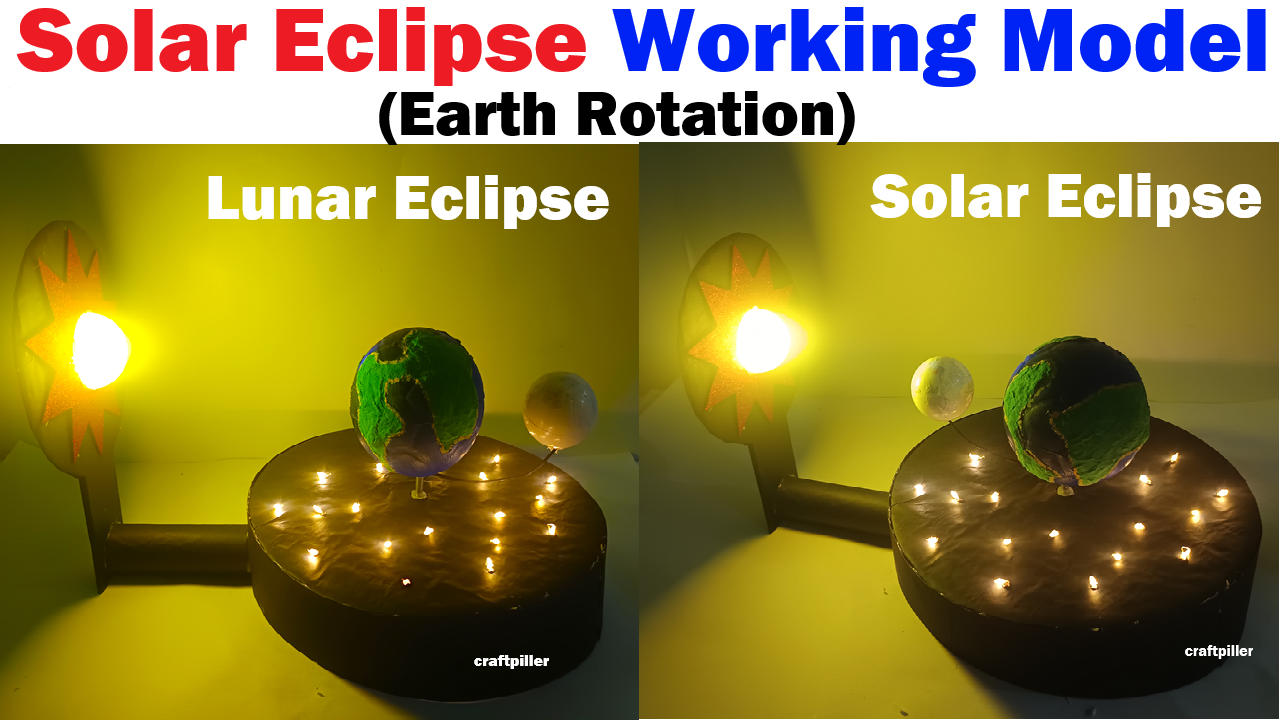
In this video, we demonstrate a 3D working model of an eclipse that shows how solar and lunar eclipses occur due to the relative positions and motion of the Sun, Earth, and Moon.
This project is perfect for school or college science exhibitions, science fairs, and classroom demonstrations because it turns abstract astronomy into a visual and interactive experience that everyone can understand.
A working model like this helps explain some of the most fascinating celestial phenomena in our solar system using simple materials and easy-to-build mechanics.
What the Model Explains
An eclipse happens when the Sun, Earth, and Moon align in space in a straight line.
- In a solar eclipse, the Moon comes between the Sun and Earth, casting a shadow on Earth’s surface and blocking sunlight partially or completely.
- In a lunar eclipse, the Earth comes between the Sun and the Moon, and Earth’s shadow falls on the Moon, causing it to darken.
Both these phenomena are triggered by orbital motion — Earth’s rotation on its axis and the Moon’s revolution around Earth. A dynamic model can show these alignments and shadows in real time on a small scale, making it easy for students to visualize and explain at exhibitions.
Materials You’ll Need
- Big ball or styrofoam sphere (to represent Earth)
- Small ball (for the Moon)
- LED light or bulb (to simulate the Sun)
- Cardboard or foam base
- Thin rods, sticks, or wires (to mount and support spheres)
- Paints and markers (to decorate Earth and Moon)
- DC motor or slow-running motor (optional, for rotation)
- Battery pack, wires, and switch for LEDs and motor
- Glue, scissors, and craft tools
How the Eclipse Model Works
Base and Setup
Start by fixing the big ball (Earth) on a sturdy base. Paint it blue and green to represent oceans and land. Place an LED light at one end of the base — this will act as the Sun.
Mounting the Moon
Attach the smaller ball (Moon) on a stick or arm near Earth. You can mount it so it can move around Earth or be rotated manually to simulate the Moon’s orbit.
Showing Eclipse Alignment
When the LED light (Sun) is switched on and the Moon is positioned between the Sun and Earth, the Moon will cast a shadow on the Earth model. This is a solar eclipse demonstration — where sunlight is blocked from reaching Earth.
To show a lunar eclipse, position Earth between the Sun and Moon. Earth’s shadow then falls on the Moon — visible as the Moon turning darker.
Educational Explanation
Earth’s Rotation & Moon’s Orbit
While Earth rotates on its axis every 24 hours, the Moon orbits around Earth roughly once every 27 days. The position of these bodies relative to the Sun determines whether an eclipse can happen. Alignments must occur in a straight line — called syzygy — for eclipses to happen.
Why Eclipses Don’t Happen Every Month
Although the Moon orbits Earth every month, eclipses don’t occur monthly because the Moon’s orbit is slightly tilted relative to Earth’s orbit around the Sun. This tilt means alignments only happen occasionally — which is why solar and lunar eclipses are exciting events to observe.
Why This Model Is Great for Exhibitions
A working eclipse model transforms complex astronomy concepts into something tangible and visible. Instead of just talking about or drawing diagrams of eclipses, students and visitors can directly see the effect of shadows and understand how celestial motions interact.🌔
This model also integrates basic electronics (LEDs and motors), art and craft skills, and astronomical concepts — making it interdisciplinary and ideal for school projects.