
Introduction
Water is one of the most precious natural resources, especially in agriculture. Traditional irrigation methods like flood irrigation lead to a huge loss of water due to evaporation, runoff, and seepage. To solve this problem, modern agriculture uses drip irrigation, a highly efficient water-saving technique. Drip irrigation delivers water directly to the root zone of plants in a slow and controlled manner, ensuring minimum wastage and maximum absorption.

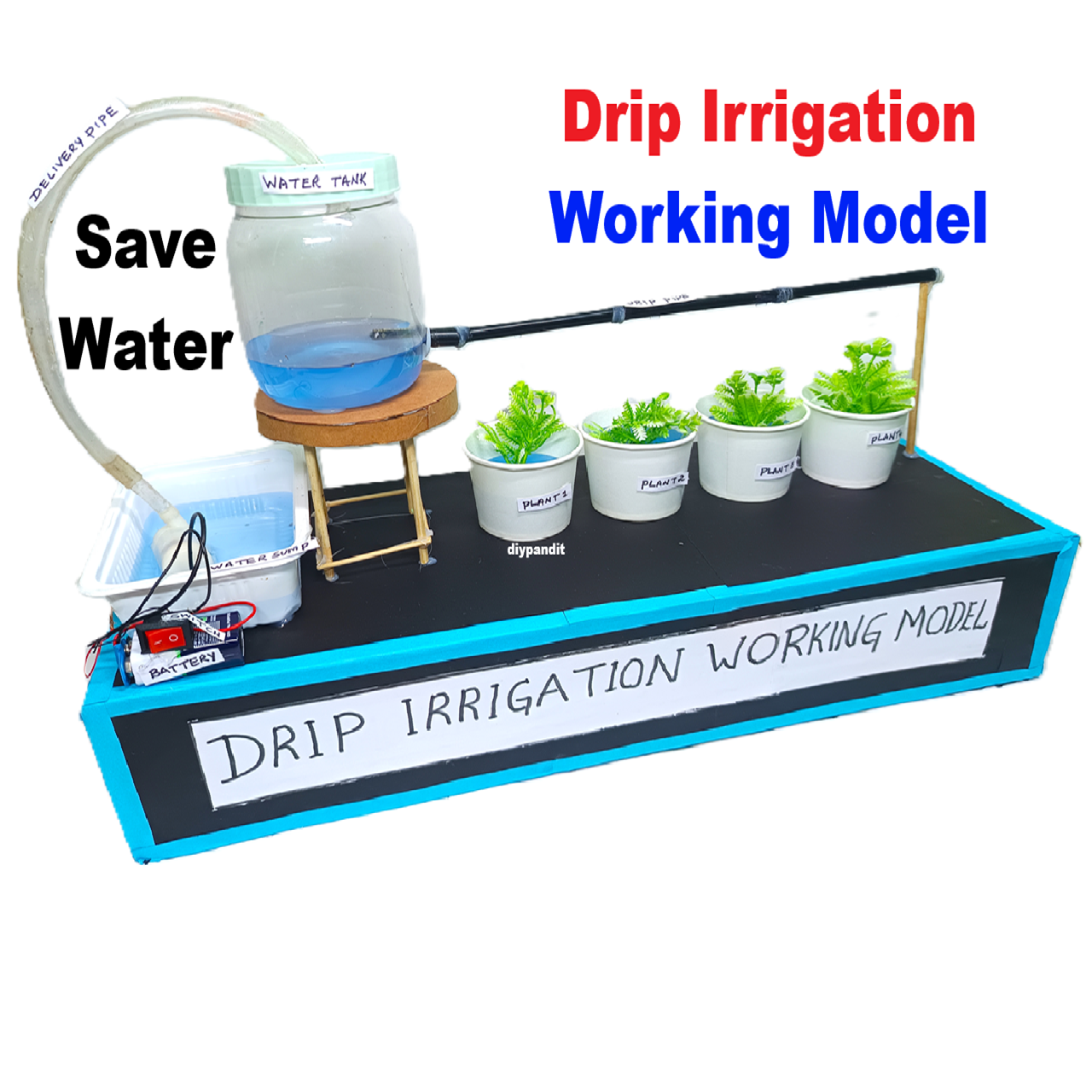
This Drip Irrigation Working Model is a DIY agriculture science exhibition project designed using simple, low-cost materials such as cardboard, pipes, syringes or bottles. The model clearly demonstrates how water is supplied drop by drop to plants, making it ideal for school exhibitions, science fairs, and environmental awareness programs.
Aim of the Project
The main objectives of this project are:
- To understand the concept of drip irrigation
- To demonstrate efficient water management in agriculture
- To show how water reaches plant roots directly
- To promote sustainable and smart farming practices
- To create awareness about water conservation
Importance of Drip Irrigation
Agriculture consumes nearly 70% of the world’s freshwater. Drip irrigation plays a major role in conserving water and improving crop yield. Its importance includes:
- Reduces water wastage
- Increases crop productivity
- Saves energy and labor
- Prevents soil erosion
- Suitable for water-scarce regions
Materials Used
The materials required for making the drip irrigation working model are:
- Cardboard (base and farm layout)
- Color paper or chart paper
- Plastic pipes or IV tubes
- Syringes or plastic bottles (water tank)
- Small straws or pin pipes
- Soil or sand
- Artificial or real small plants
- Glue, tape
- Scissors, cutter
- Marker pens for labeling
Concept of Drip Irrigation
Drip irrigation is a method where water is supplied drop by drop directly to the plant roots through a network of pipes, valves, and emitters. This system works at low pressure and ensures uniform water distribution.
Unlike flood irrigation, drip irrigation does not wet the entire field. Only the root zone receives water, which reduces evaporation and weed growth.
Description of the Drip Irrigation Model
The model is built on a flat cardboard base representing an agricultural field. Small rows are marked to show crop lines. A water tank is placed at one side or at a raised height to create gravity flow.
Thin plastic pipes or IV tubes run from the tank across the field. Small holes or pin pipes act as emitters, allowing water to drip slowly near each plant’s roots.
Construction of the Model
- A cardboard base is prepared and painted green and brown to represent farmland
- Small plants are fixed in rows using clay or soil
- A water tank (syringe or bottle) is mounted at a height
- Main pipeline is connected from the tank
- Branch pipes are laid along plant rows
- Small holes are made near each plant for drip flow
- Labels are added for explanation
Working Principle of the Drip Irrigation Model
The working of the drip irrigation model is simple and effective:
- Water is filled into the tank or syringe
- When pressure is applied or the valve is opened, water flows through pipes
- Water comes out slowly in drops through small holes
- Drops fall directly near plant roots
- Plants absorb water efficiently with minimum loss
This demonstrates controlled irrigation and efficient water use.
Scientific Principle Behind Drip Irrigation
Drip irrigation works on the principles of:
- Gravity flow or low pressure flow
- Capillary action in soil
- Controlled discharge through narrow openings
The slow flow rate ensures better soil moisture retention and prevents waterlogging.
Advantages of Drip Irrigation
- Saves up to 50–70% water
- Improves crop yield and quality
- Reduces weed growth
- Minimizes soil erosion
- Reduces fertilizer loss
- Suitable for all soil types
Disadvantages of Drip Irrigation
- Initial installation cost is high
- Pipes can get clogged
- Requires regular maintenance
Applications of Drip Irrigation
- Vegetable farming
- Fruit orchards
- Greenhouses
- Flower cultivation
- Dry and semi-arid regions
Role of Drip Irrigation in Sustainable Agriculture
Drip irrigation supports sustainable agriculture by:
- Conserving water resources
- Increasing food production
- Reducing energy consumption
- Supporting farmers in drought-prone areas
It plays an important role in smart farming and climate-resilient agriculture.
Environmental Benefits
- Prevents overuse of groundwater
- Reduces water pollution
- Maintains soil health
- Supports eco-friendly farming
Educational Importance of the Model
- Helps students understand modern irrigation techniques
- Encourages innovation in agriculture
- Ideal for science exhibitions and viva
- Demonstrates real-life problem-solving
Conclusion
The Drip Irrigation Working Model is an effective and educational science project that demonstrates smart water management in agriculture. By using simple DIY materials like cardboard and pipes, this model explains how drip irrigation conserves water and increases crop productivity.
This project highlights the importance of sustainable farming practices and water conservation, making it highly suitable for science exhibitions, school projects, and agricultural awareness programs.
Save Water – Grow More – Secure the Future.