
Introduction
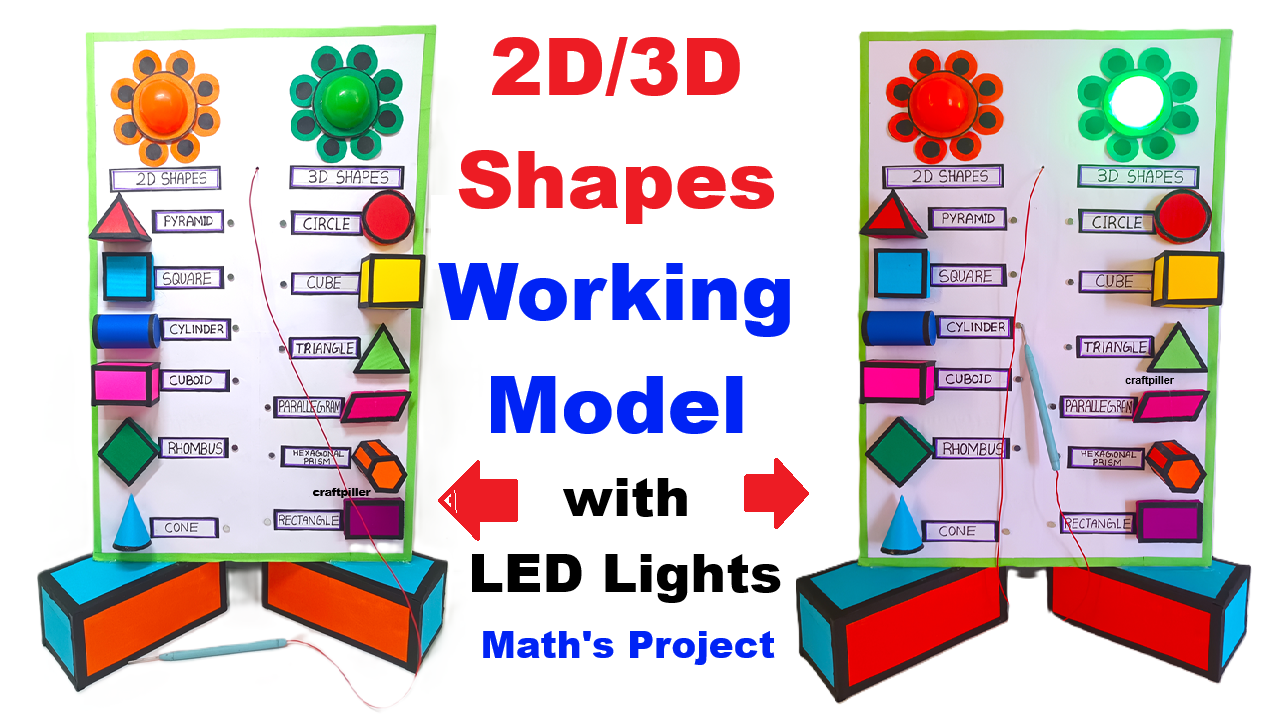
This 2D and 3D Shapes Working Model is designed to help students clearly understand the difference between two-dimensional (2D) shapes and three-dimensional (3D) shapes.
The model uses real shape cut-outs and LED indicators to make learning interactive and visual.
Aim of the Model
The main aim of this model is to:
- Differentiate between 2D and 3D shapes
- Help students identify shapes easily
- Provide instant feedback using LED lights
- Make geometry learning fun and hands-on
Concepts Used
- Plane figures (2D shapes)
- Solid figures (3D shapes)
- Shape identification
- Basic electric circuit (LED, battery, wire)
Main Parts of the Model
1. Base Stand
- A strong base supports the vertical display board
- Covered with colorful chart paper
- Makes the model stable and attractive
2. Vertical Display Board
- Divided into two clear sections:
- 2D Shapes
- 3D Shapes
- Each section is labeled at the top
3. LED Indicators
- Orange LED → 2D Shapes
- Green LED → 3D Shapes
- LED lights glow to show the correct category
4. Shape Models
2D Shapes Section:
- Circle
- Square
- Rectangle
- Triangle
- Rhombus
- Parallelogram
3D Shapes Section:
- Cube
- Cuboid
- Cylinder
- Cone
- Pyramid
- Hexagonal prism
Each shape is made using cardboard or foam sheets and fixed neatly.
5. Probe and Contact Points
- Each shape has a metal contact point
- A probe wire is used to touch the shape name
- This completes the circuit
How the Model Works (Step-by-Step)
Step 1: Select a Shape
The student chooses a shape name or touches the shape with the probe.
Example:
- Square
- Cube
Step 2: Touch with the Probe
- The probe touches the contact point next to the selected shape
- The electrical circuit gets completed
Step 3: LED Glows Automatically
- If the shape is 2D, the 2D LED glows
- If the shape is 3D, the 3D LED glows
This gives instant visual confirmation.
Example Demonstration
- Touch Circle → 2D LED glows
- Touch Triangle → 2D LED glows
- Touch Cube → 3D LED glows
- Touch Cylinder → 3D LED glows
Why This Is a Working Model
- Uses an electrical circuit
- Requires student interaction
- Produces automatic LED response
- Demonstrates real-time classification
Educational Benefits
- Clears confusion between 2D and 3D shapes
- Encourages learning by doing
- Improves visual memory
- Useful for primary and middle school students
- Excellent Teaching Learning Material (TLM)
Applications
- Maths exhibitions
- Classroom geometry lessons
- Concept revision
- Interactive quizzes
Conclusion
The 2D / 3D Shapes Working Model with LED Lights converts abstract geometry concepts into a simple, interactive learning experience. By touching a shape and observing the glowing LED, students instantly understand whether the shape is two-dimensional or three-dimensional. This model makes geometry easy, engaging, and enjoyable.